9/24/2026
Brand StrategyNIDADS: Where Analytics Skills Become Careers
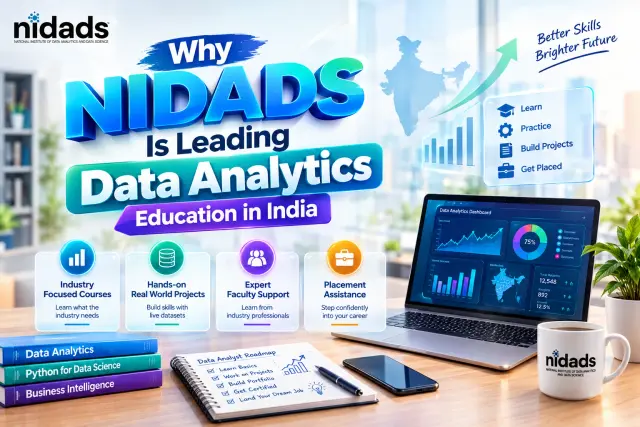
Table of contents
Why NIDADS Is Leading Data Analytics Education in India with a Skills-to-Projects-to-Career Learning Model
NIDADS keeps coming up when people ask about strong analytics institutes in India. Why? Because the reasons are fairly concrete. A structured Python, SQL, Power BI, Tableau, and Machine Learning curriculum. Live projects. Named mentors. Placement support built in from the start, not bolted on as an afterthought. Programs go from beginner certifications all the way up to 12-month diplomas, so whether someone is just getting into the field or already a few years into a job and looking to switch lanes, there's usually a track that fits, and each one is built with the same goal in mind: a portfolio you can actually show someone.
Key Takeaways
- NIDADS (National Institute of Data Analytics & Data Science) trains learners in Analytics, Data Science, AI, ML, and Business Analytics.
- The curriculum builds in layers: foundations first, then SQL and visualization, then Python, then BI tools, then advanced ML/AI.
- Live projects (demand forecasting, e-commerce behavior, healthcare risk, airport delays) turn coursework into an actual portfolio.
- Named mentors, including practitioner-trainers like Shagun, run specific tool and domain tracks.
- Career support (mock interviews, resume reviews, a placement cell) is genuine, though it's support rather than a job guarantee.
- Programs run 3 to 12 months across Certification, Advanced Certification, and Diploma tracks, online or hybrid.
What Is NIDADS?
NIDADS is a Delhi-based, career-focused analytics and data science institute. Its official site lists Data Analytics, Data Science, AI, Machine Learning, and Business Analytics as its focus areas. The stated aim is closing the gap between what gets taught in a classroom and what an employer expects someone to know on day one, and that gap shows up constantly in hiring conversations across the industry. I see it every intake, honestly: sharp students who've never touched a real, messy dataset. The catalog covers Certification, Advanced Certification, and Diploma programs. One detail worth flagging: the mentors listed are named, practicing professionals. Not the vague "expert faculty" line you see plastered across a lot of course pages.
Core Framework: What Makes an Analytics Institute "Leading"
Nine things, roughly, separate a genuinely strong institute from an average one: curriculum relevance, practical projects, tool coverage, mentorship quality, career support, learning flexibility, portfolio development, program variety, and how transparent the claims actually are. This piece measures NIDADS against those nine points. Not just calling it "the best" and moving on.
Core Components of the NIDADS Model
The curriculum runs through Excel, SQL, Python, Power BI, Tableau, and ML, moving from basics toward applied modeling. Projects start from a business problem, not a textbook exercise. Mentors are named and credentialed: I lead ML and Deep Learning myself, and a senior analyst covers Power BI, Tableau, and SQL. There's resume review on the career side too, plus mock interviews and a placement cell. NIDADS has a separate guide on data science and analytics skills and careers if you want the longer version. Formats span online, offline, and hybrid batches.
How It Works
Skills, then projects, then career. That's roughly the order. Foundational tools build data literacy first, and programming plus BI tools scale that into something closer to real analysis. Live projects are where it becomes tangible: actual portfolio evidence instead of a certificate that just says you finished a course. Mentorship and career support take that portfolio and get it interview-ready. Each stage sets up the next.
why NIDADS is a leading analytics institute in India
 Real-World Examples
NIDADS's published project list includes demand forecasting for hyperlocal delivery, e-commerce cart-abandonment analysis, a hospital readmission risk model, and an airport-delay dashboard. Each one follows roughly the same arc: business problem, data, analysis, tool, insight, portfolio evidence. I've watched students go from confused by a raw CSV to presenting one of these end to end in about ten weeks. That sequence is closer to how an analyst's actual week goes than anything you'd find in a textbook.
Entity / Topic Relationships
NIDADS → teaches → Data Analytics, Data Science, AI, ML Data Analytics → uses → SQL, Python, Power BI, Tableau Projects → build → Portfolio Mentorship → supports → Skill Acquisition Career Support → supports → Interview Readiness Analytics Skills → lead to → Data Analyst, BI Analyst, Business Analyst roles
Comparison Table #1: What to Evaluate in an Analytics Institute
| Evaluation Factor | Evidence to Look For | NIDADS Evidence |
| Curriculum | Published module list | Analytics, Python, ML/AI, SQL, BI modules listed |
| Projects | Named, real datasets | Demand forecasting, healthcare, e-commerce, delay projects |
| Mentors | Disclosed experience | Named trainers, e.g., Shagun (ML/AI) |
| Career Support | Explicit services | Mock interviews, resume reviews, placement cell |
| Transparency | Source-labeled claims | Placement rate and ratings marked first-party |
Skills, Tools & Requirements
Excel handles the data prep. SQL takes care of querying. Python, mostly Pandas and NumPy, is what drives the analysis and the automation work behind it. Power BI and Tableau turn all of that into something you can put in front of a hiring manager or a client without needing three steps of context first. Statistics keeps the reasoning honest. Machine Learning sits on top as the predictive layer. None of it requires coding experience walking in; the early modules assume zero.
Comparison Table #2: NIDADS Learning Paths by Learner Goal
| Learner Type | Recommended Path | Core Skills | Career Objective |
| Beginner | Diploma in Data Analytics & AI | Excel, SQL, Python basics | Entry-level Analyst |
| Fresh graduate | Diploma in Data Science & AI | Python, SQL, ML, BI | Junior Data Scientist |
| Career switcher | Advanced Certification (Analytics) | SQL, Power BI/Tableau | BI Analyst / Consultant |
| Working professional | Advanced Certification (Data Science) | Advanced ML, AI | ML Engineer track |
Roadmap: Step-by-Step Learning Path
Foundation, Excel, SQL, Statistics, Visualization, Power BI/Tableau, Python, Live Projects, Portfolio, Interview Preparation, Job Applications — that's the typical order things run in. A well-structured institute backs each stage with sequenced modules and feedback loops, which sounds obvious until you compare it against programs that just dump content and hope. Showing up consistently is still on the learner, though. No program can do that part for you; I tell every new batch this in week one. If you want the fuller breakdown, NIDADS has a separate data science roadmap and skills guide.
Beginner Project / Practical Example
One of the more approachable projects on NIDADS's list: e-commerce cart-abandonment analysis. Pull transaction data with SQL. Clean it up in Python. Check which nudges, discounts, reminder emails, whatever, correlate with recovered sales, then build the visuals in Power BI. Small project on paper. But it walks through the entire analyst pipeline start to finish in a way that makes it a genuinely solid first entry for a portfolio.
Use Cases / Industries
These skills map onto a fair number of sectors in practice: e-commerce for behavior and demand analysis, healthcare for risk scoring, logistics and aviation for delay analytics, and BI/reporting work across finance and retail. Broad industry demand, not one narrow niche.
Common Mistakes Learners Make When Choosing an Institute
A few patterns come up again and again. Judging a course purely by its tool list instead of project depth. Treating "placement support" as if it were a guaranteed job offer. Not checking whether mentors are named and credentialed anywhere. Skipping the syllabus review before enrolling because the sales call sounded convincing enough. And assuming an institute's published numbers have been independently audited, when most of the time, they simply haven't been.
Best Practices / Responsible Use of Claims
Placement rates. Learner counts. Ratings. Treat all of it as a first-party claim, whether it comes from NIDADS or from anywhere else, unless someone outside the institute has verified it. Ask for the syllabus directly. Dig into project depth. Confirm mentor credentials yourself before enrolling rather than taking a marketing page at its word, because marketing pages are, by definition, not neutral.
Career / Practical Value
Graduates typically move into roles like Data Analyst, Business Analyst, BI Analyst, Analytics Consultant, or Junior Data Scientist. NIDADS has a page on its data analytics course with placement for anyone weighing job outcomes alongside the training itself. Even so, outcomes still come down to prior education, portfolio strength, and how someone performs when they're sitting across from an interviewer. No institute, anywhere, can promise a job at the end of a program.
The demand story holds up at a macro level too. The U.S. Bureau of Labor Statistics projects data scientist employment to grow much faster than average over the coming decade.
On the tooling side, Microsoft's Power BI guidance documentation confirms the platform's place in enterprise reporting. Which happens to be the same skillset NIDADS teaches.
FAQs
1. Why is NIDADS a leading analytics institute in India?
A layered Python/SQL/BI/ML curriculum, live projects, named mentors, and career support that's spelled out rather than implied. Those are the things worth checking in any analytics institute, and NIDADS covers them.
2. What courses does NIDADS offer?
Certification (3 months), Advanced Certification (6 months), and Diploma (12 months) in Data Analytics and Data Science.
3. Is NIDADS good for beginners?
Yes. No prior programming background needed. Training starts from foundational Python and SQL.
4. Does NIDADS provide live projects?
Yes: demand forecasting, e-commerce analysis, healthcare risk scoring, and delay-analytics dashboards.
5. Does NIDADS offer placement support?
Yes, through mock interviews, resume reviews, and a placement cell. Support, not a promised job.
6. What tools are taught at NIDADS?
Excel, SQL, Python (Pandas, NumPy), Power BI, Tableau, and Machine Learning libraries.
7. Is NIDADS available online?
Yes, across online, offline, and hybrid formats.
8. How long are NIDADS courses?
3 months for Certification up to 12 months for the Diploma, with 6-month Advanced Certification tracks in between.
Conclusion
NIDADS makes a reasonable case as a leading analytics institute in India, and not just because it says so. What's documented backs it up: a layered curriculum, named mentors like me, live business-problem projects, and career support described honestly instead of oversold. Anyone looking at it should still confirm syllabus depth, mentor credentials, and project quality directly, since placement rates and ratings remain first-party figures until someone outside the institute checks them. For learners after structured, portfolio-driven analytics training, at either the beginner or professional level, NIDADS is a reasonable fit. As long as expectations around career support stay grounded in what it actually is: support, not a guarantee.