8/6/2026
Data ScienceData Science Roadmap: Build Intelligence That Outlasts AI
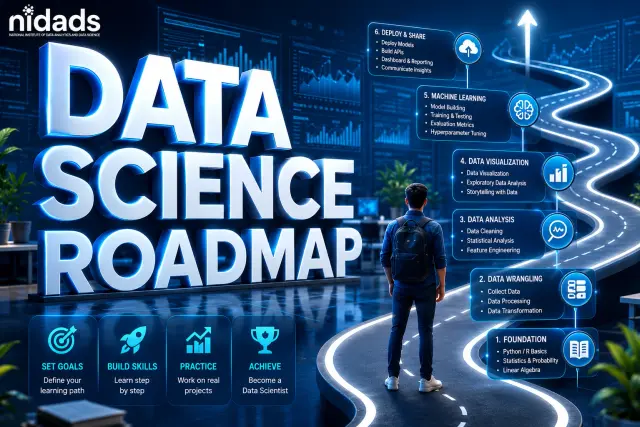
Table of contents
Data Science Roadmap: Master the Skills, Systems and Strategic Thinking Behind Every Great AI Professional
A data science roadmap lays out what to learn and in what order — basic math, Python, SQL, statistics, visualization, machine learning, and eventually deployment — so a beginner isn't guessing which skill comes next. And the field isn't slowing down. The US Bureau of Labor Statistics lists data scientist as the 4th fastest-growing occupation in the country, projecting 34% employment growth between 2024 and 2034.
Key Takeaways
● BLS projects 34% growth in data scientist jobs from 2024 to 2034 — roughly 23,400 openings a year.
● Fresher salaries in India usually land between ₹4–10 LPA, climbing to ₹12–15 LPA nationally with a few years of experience.
● US entry-level pay commonly starts above $95,000; the national median sits near $112,590 (May 2024, BLS).
● The global data science platform market was worth $13.6 billion in 2025, on track to hit $57.1 billion by 2032 (Coherent Market Insights).
● A GitHub portfolio with 3+ real projects tends to push fresher offers toward the higher end of the range.
● Prompt engineering, RAG, and LLM evaluation are now baseline expectations in most 2026 job postings.
What Is a Data Science Roadmap?
A data science roadmap isn't a checklist you tick off in any order — it's a sequence. Basic math comes before Python, Python before statistics, statistics before serious machine learning. Most roadmaps skip this and just say "learn Python, SQL, ML," without saying how deep to go before moving forward. That's exactly where self-taught learners get stuck.
The demand isn't hype: BLS lists data scientist as the fourth fastest-growing US occupation, driven by AI model development and data-driven decisions, and India is seeing analytics roles open up faster than traditional IT.
Job Market and Growth Outlook in 2026
Two things are pushing this growth: a genuine shortage of skilled people, and an analytics market that keeps getting bigger, with retail, BFSI, healthcare, and logistics all building out data teams for the first time.
In the US, BLS numbers are the clearest reference: 34% growth from 2024 to 2034, roughly 23,400 openings a year — well above the 3% average across all occupations. A structured data science course helps mainly because it forces the right pacing instead of guesswork.
Skills You Actually Need, In the Correct Order
Employers care whether you can move data from raw to decision. Here's the order that avoids the most dropout:
1. Basic math: linear algebra, calculus, and probability — just enough to understand how a model learns.
2. Python. Syntax first, then pandas and numpy, since that's what you'll use daily once you're working with real data.
3. SQL — SELECT, JOIN, GROUP BY, window functions. Most data lives in a database, not a CSV.
4. Statistics and probability, covered in statistics for data science. Distributions, hypothesis testing, correlation vs. causation — the stage most self-taught learners quietly skip.
5. Data visualization: matplotlib/seaborn for exploring data, one BI tool (Power BI or Tableau) for presenting it.
6. Machine learning — regression, classification, ensembles, evaluation metrics via scikit-learn.
7. Deep learning and generative AI. Neural network basics, then PyTorch or TensorFlow, plus enough LLM and RAG knowledge to be useful in 2026.
8. Cloud and MLOps: one platform (AWS, Azure, or GCP), Docker basics, and enough vocabulary to explain production.
If there's one gap that shows up more than any other in self-taught plans, it's statistics — people rush past it toward modeling, and it costs them in interviews.
 Data Science Career Snapshot: India vs United States (2026)
| Factor | India | United States |
| Fresher Salary Range | ₹4–10 LPA | $62,000–$95,000+ |
| Average Pay (All Levels) | ₹12–15 LPA | $120,000+ median |
| Job Growth Outlook | Strong, concentrated in BFSI, IT, retail | 34% growth, 2024–2034 (BLS) |
| Core Tools Expected | Python, SQL, Power BI/Tableau | Python, SQL, cloud ML tools, GenAI |
| Portfolio Impact | ₹3–5 LPA higher with 3+ real projects | Directly correlated with interview conversion |
The pattern holds on both sides of the world: salary in the first two or three years tracks your tool stack and portfolio more than how long you've been working. Someone who only knows Excel plateaus fast. Add Python, SQL, and a cloud certification in year one, and that curve looks very different.
Learning Path and Certifications
Certifications are useful for getting past resume screening, but they won't replace a project you can actually walk someone through. The most recognized entry-level options:
| Certification | Provider | Duration | Best For |
| Google Data Analytics | Google (Coursera) | 3–6 months | Broad foundation from zero |
| IBM Data Science Professional Certificate | IBM (Coursera) | 5–6 months | Python, SQL, and ML in one track |
| AWS Certified Machine Learning | Amazon | 2–4 months | Cloud-focused ML roles |
| Azure Data Scientist Associate | Microsoft | 2–4 months | Microsoft-stack employers |
None of them replace a portfolio a recruiter can open and understand in two minutes, though. If the statistics layer still feels shaky, a data science and analytics program that treats it as its own module, rather than a two-week detour inside a bigger course, usually works better.
Portfolio Projects and Common Mistakes
Projects that get interviews follow a difficulty curve: cleaning-and-EDA, a supervised project tied to a real business question, one pulling data via SQL instead of a clean CSV, and a deployment — even a basic Streamlit app counts. Titanic and Iris are so overused they barely register as effort anymore.
The mistakes repeat too: listing tools you've never built anything with, sending the same resume everywhere, freezing when asked why you picked a particular model. A program pairing each concept with a graded project catches this earlier than solo tutorials.
90-Day and One-Year Roadmap
90 days: Month 1 — Python and SQL. Month 2 — statistics, visualization, second project. Month 3 — machine learning plus a third, evaluation-focused project.
One year: Months 1–3 as above. Months 4–6 — deeper ML and two full projects. Months 7–9 — a specialization (deep learning, GenAI, or MLOps), one cloud certification, portfolio buildout. Months 10–12 — interview prep and applications.
Remote Work and the AI Factor
Remote and hybrid roles haven't gone away, though there's more competition for them now. AI hasn't killed entry-level demand the way many predicted — practitioners mostly use it to clear repetitive work, freeing time for interpretation and communication, which is still where freshers struggle most in interviews.
Worth checking directly if you want to verify any of this yourself: the BLS Occupational Outlook Handbook for data scientists, the Google Data Analytics Professional Certificate on Coursera, and LinkedIn's Economic Graph workforce reports. The salary figures above are also broadly consistent with what Glassdoor, NASSCOM, and Naukri report for the Indian market.
Conclusion
The roadmap that actually works comes down to sequence: basic math and Python before statistics, statistics before machine learning, and machine learning before you touch deep learning, MLOps, or generative AI. The job numbers back this up — 34% projected growth in the US through 2034, strong hiring momentum in India, and salaries that track your tool stack and portfolio far more than your years of experience. Work through the plan above, build something real at each stage, and treat your GitHub profile as the first interview you'll actually face.
Frequently Asked Questions
Is data science still worth learning in 2026?
Pretty much, yes. BLS projects 34% employment growth for data scientists through 2034 — one of the fastest-growing occupations it tracks, driven by real infrastructure and AI investment.
What is the average fresher salary for data scientists in India?
Somewhere between ₹4 LPA and ₹10 LPA for most freshers. Candidates with a strong project portfolio tend to land at the upper end of that range rather than the middle.
Should I learn Python or R first?
Python, for most people — it's the broadly useful language across analysis, ML, deep learning, and AI. R still has a place in specialized statistical research, but it's not where beginners should start.
Do I need a degree to become a data scientist?
Not necessarily. Many practitioners are self-taught or bootcamp-trained; without a degree, a portfolio someone can actually look at matters more.
Is generative AI knowledge required for data science jobs now?
More and more, yes. Prompt engineering, LLM evaluation, and basic RAG knowledge now show up even in "traditional" data science postings.
How long does it realistically take to become job-ready?
About 9 to 12 months starting from zero. Coming from an adjacent field like software engineering, 90 days is realistic.
Which certification is best for a complete beginner?
The Google Data Analytics Professional Certificate — it assumes no technical background and starts with SQL, spreadsheets, and visualization first.
Do I need advanced mathematics before starting data science?
No — basic math alongside Python is enough to start. Deeper linear algebra and calculus matter more once you reach machine learning and deep learning.
About the Author
Quick facts
Name: Shagun
From: Delhi
Education: B.Tech
Program: Data Science and Data Analytics
Placed in: NIDADS (National Institute of Data Analytics & Data Science)
Covers topics: Data Science, Data Analytics, Artificial Intelligence, Machine Learning, Data Engineering, Deep Learning
Currently working as: Senior Data Science Trainer
In her words: "The best way to learn data science isn't just solving problems — it's understanding why the solution works. That's what I try to teach every single day."