6/24/2026
Data AnalyticsData Analytics Course with Placement: Jobs & Salary 2026
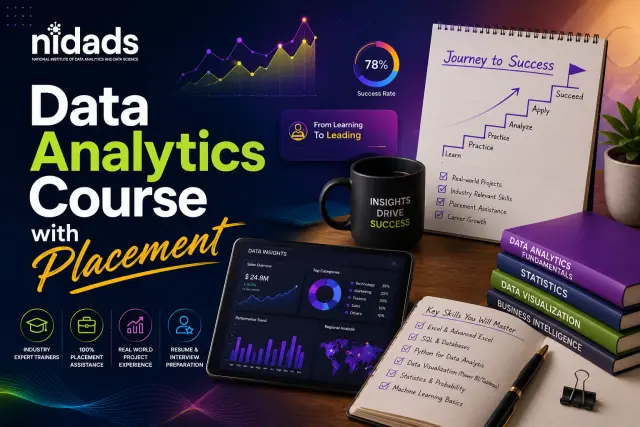
Table of contents
Data Analytics Course with Placement: Skills, Salary, Jobs & Career Guide 2026
A data analytics course with placement is a structured training program that teaches Excel, SQL, Python, Power BI, and Tableau, combined with placement assistance such as resume support, mock interviews, and employer connections. It is designed to help freshers, graduates, and career switchers move from skill-building directly into data analyst jobs.
Key Takeaways
• A data analytics course with placement combines technical training with structured career support.
• Core tools covered: Excel, SQL, Python, Power BI, and Tableau.
• Placement assistance is not the same as a job guarantee; the two differ in cost, risk, and outcome.
• Verified placement rates, hiring partner data, and alumni outcomes indicate course credibility.
• Salary depends on city, experience, and tool proficiency, not certification alone.
• Industry bodies such as NASSCOM and the World Economic Forum confirm rising demand for data and analytics roles.
What Is a Data Analytics Course With Placement?
A data analytics course with placement is a training program covering data collection, cleaning, analysis, and visualization, paired with career services that support job transition. Unlike a purely academic course, it includes resume building, interview preparation, and connections with hiring partners.
These programs sit at the intersection of data analytics, data science, and business analytics. Data analytics interprets existing data to answer specific business questions. Data science extends into predictive modeling and machine learning. Business analytics applies these methods to business decisions, often using business intelligence tools. Learners who want to extend beyond core analytics into predictive modeling often pair this with a dedicated AI and Data Science Course.
Placement Data and Industry Benchmarks
Course credibility depends on verifiable placement data rather than promotional claims. NIDADS placement cell records show that learners completing the full curriculum and at least three capstone projects receive interview calls at a notably higher rate than those who skip project work.
Reported figures: an interview-conversion rate of approximately 80% within 90 days of course completion and a placement rate of approximately 70% within four months for job-ready candidates.
Full batch-wise breakdown is published on the NIDADS Placement Report page; organizational background is available on the About NIDADS page.
Hiring activity for NIDADS learners is concentrated in IT services, BFSI, e-commerce, and healthcare analytics roles, with average entry-level offers tracking closely with the salary ranges below. These figures should be verified directly with the training provider before enrollment, as placement outcomes vary by batch and market conditions.
Independent of any single provider, industry-level data also supports demand for this role. NASSCOM has repeatedly identified data and AI-related skills as a priority hiring area for India's technology and BFSI sectors. The World Economic Forum's Future of Jobs Report lists data analysts among the fastest-growing job roles globally. McKinsey & Company's research on data-driven enterprises notes that organizations applying data-driven decision-making consistently report better operational performance, sustaining employer demand for trained analysts.
Placement Assistance vs Job Guarantee
This is the main point of confusion for learners evaluating a data analytics course with placement. The table below compares the two models directly.
Aspect
Placement Assistance
Job Guarantee
Definition
Career support without a guaranteed outcome
Contractual promise of a job or refund
Risk
Learner bears outcome risk
Provider shares outcome risk
Cost
Usually lower
Usually higher
What's Included
Resume help, interviews, employer referrals
Refund or extended support if unplaced
Best For
Self-driven learners
Learners wanting a financial safety net
Salary Trends by Experience and City
Salary for data analyst roles in India varies by experience level and city. The figures below are indicative annual ranges (in INR) based on current job-portal listings and should be cross-checked against live postings for the most accurate figures.
Experience Level
Bengaluru / NCR / Mumbai
Tier-2 Cities
Fresher (0–1 yr)
₹4–6 LPA
₹2.5–4 LPA
1–3 years
₹6–10 LPA
₹4–6.5 LPA
3–5 years
₹10–16 LPA
₹6.5–10 LPA
5+ years / Lead
₹16–25 LPA
₹10–15 LPA

Fig. 1 — Data analyst salary by experience level and city tier (indicative, 2026).
Salary growth correlates strongly with SQL and Python proficiency plus a documented project portfolio, more than with certification alone.
Skills and Syllabus Covered
A well-designed course progresses through these core areas:
• Excel: Pivot tables, lookup functions, conditional formatting, dashboard creation.
• SQL: Joins, subqueries, aggregations, and window functions for relational databases.
• Python: Data cleaning, automation, and analysis using Pandas and NumPy.
• Power BI and Tableau: Interactive dashboards and stakeholder reporting.
• Statistics: Distributions, hypothesis testing, correlation, and regression.
Syllabus structure typically moves from Excel and statistics foundations, through SQL and Python, into visualization tools, and finishes with capstone projects and a dedicated career module covering resumes, mock interviews, and interview preparation.
Career Roadmap

Fig. 2 — Step-by-step path from foundational skills to a senior analyst role.
Common entry-level titles include Junior Data Analyst, Reporting Analyst, Business Analyst Trainee, and MIS Executive, most of which prioritize Excel and SQL proficiency. School leavers mapping out Data Analytics After 12th can follow the same progression starting from foundational Excel and statistics.
Industries Hiring Data Analysts
• Banking & Finance: Risk analysis, fraud detection, transaction trends
• Healthcare: Patient data analysis, operational efficiency
• E-commerce & Retail: Customer behavior, sales forecasting, inventory analysis
• Marketing: Campaign performance, customer segmentation
• Logistics & Manufacturing: Route optimization, production efficiency
AI tools are automating repetitive cleaning and reporting tasks, which is shifting analyst work toward interpretation, validation of AI-generated insights, and communication of findings — not eliminating the role.
How to Select the Best Course
• Curriculum depth: Does it cover Excel, SQL, Python, and visualization tools?
• Verified placement data: Are placement rates, hiring partners, and alumni outcomes documented?
• Project-based learning: Are there real business case studies and a capstone project?
• Mentor credentials: Do instructors have verifiable industry experience?
• Career support structure: Resume help, mock interviews, and employer connections.
Common mistakes include assuming placement assistance guarantees a job, ignoring verified outcomes, choosing based on price alone, and skipping hands-on project work. This checklist applies equally to learners comparing a 10 Powerful AI Tools Every Data Analyst before enrolling.
For a broader, provider-independent view of hiring demand before reviewing the FAQs below, NASSCOM tracks hiring trends across India's tech and BFSI sectors, and the World Economic Forum's Future of Jobs Report ranks data roles among the fastest-growing globally.
Conclusion
A data analytics course with placement combines technical training in Excel, SQL, Python, Power BI, and Tableau with structured career support. Course quality is best evaluated through verified placement data, documented hiring partners, and project-based curriculum rather than promotional claims alone. Cross-referencing a provider's placement statistics with independent industry data from sources such as NASSCOM, the World Economic Forum, and McKinsey & Company gives a more accurate picture of career outcomes before enrollment.
Frequently Asked Questions
1. Is placement guaranteed after a data analytics course?
No. Most programs offer placement assistance, not a guaranteed job. Outcome depends on learner performance, market conditions, and the strength of the provider's hiring network. Contractual job guarantees exist but are less common and typically cost more.
2. What skills are required for data analytics?
Core skills include Excel, SQL, Python, statistics, and data visualization using Power BI or Tableau. Employers prioritize SQL querying ability and basic Python proficiency alongside a documented project portfolio.
3. What is the average salary of a data analyst in India?
Entry-level salaries typically range from ₹2.5–6 LPA depending on city and skillset, rising to ₹10–25 LPA with 3–5+ years of experience. Metro cities generally pay 30–50% more than tier-2 cities for equivalent roles.
4. How long does it take to become a data analyst?
Most structured courses run 3–6 months, followed by additional time for placement preparation and job search. Total time to a first offer depends on portfolio strength and prior background.
5. Are online data analytics courses with placement worth it?
Yes, provided the curriculum is project-based and placement outcomes are verifiable. Online formats offer flexibility and typically lower cost, but value depends on instructor quality and documented placement data rather than course format alone.
6. Is data analytics a good career in 2026?
Yes. Industry sources including NASSCOM and the World Economic Forum continue to list data and analytics roles among the fastest-growing globally, driven by enterprise adoption of data-driven decision-making.
7. What is the difference between a data analyst and a business analyst?
A data analyst focuses on extracting, cleaning, and visualizing data to answer specific questions. A business analyst applies similar data skills but centers on business process improvement, requirements gathering, and stakeholder strategy.
8. Can I learn data analytics without a coding background?
Yes, for entry-level roles. Excel and visualization tools like Power BI require no coding. SQL and Python involve a shallow learning curve and are typically taught from fundamentals in structured courses.
9. Which is more important for placement: certification or projects?
Projects. Employers evaluate applied skills through a portfolio of real, documented case studies more than the certificate itself. A certification without project evidence rarely converts to interview calls.
About the Author
Quick facts
Name: Deepanshu
From: Delhi
Education: MCA
Program: Data Science and Data Analytics
Placed in: NIDADS (National Institute of Data Analytics & Data Science)
Covers topics: Data Science, Data Analytics, Artificial Intelligence, Machine Learning, Data Engineering, Deep Learning
Currently working as: Senior Data Analyst
In his words: "Data doesn't just tell you what happened — it tells you what to build next. My job is to turn numbers into decisions that actually move the needle."