10/13/2026
Data AnalyticsDecision Tree Algorithm: How It Works & Its Types
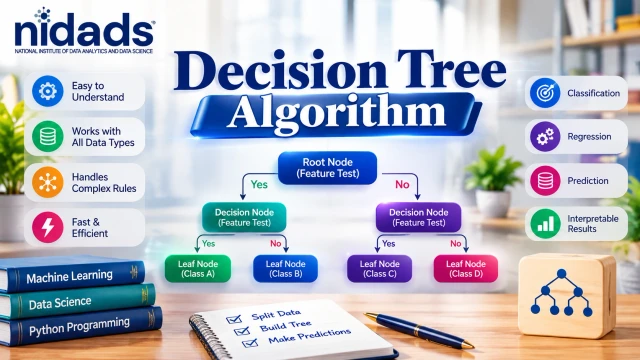
Table of contents
Algorithm of Decision Tree: What They Are, Their Types, Benefits & Drawbacks in Detail
A decision tree algorithm is known as a supervised machine learning technique which predicts results after dividing data into sub-groups as per a series of decisions. It is applicable in both classification and regression cases such as customer attrition prediction, fraud discovery, sales prediction and assessment of risks.
Key Takeaways
- Decision trees are a type of supervised machine learning model.
- They can do classification and regression.
- They work through trees composed of nodes, branches, and leaves.
- Entropy, information gain, and Gini impurity are used to define good splits.
- Pruning can be used to avoid overfitting.
- Decision trees are user-friendly; however, they can become unstable after growing.
What Is a Decision Tree Algorithm?
A decision tree operates similarly to a flowchart in that it begins with a starting point called the root node, asks a question regarding a particular observation, and guides observations to different routes depending on the outcome. The cycle goes on through various decision points and will come to the final point known as the leaf node, from where the prediction is made.
In the context of learning about machine learning, learners will benefit from understanding how supervised learning makes use of labelled data to establish the relationship of decision trees with supervised learning.
For example, a tree may be used by banks to determine the probability of a customer who may default on a loan. These factors in running its decision, thus the factors could point out income, credit history, and existing debt. After weighing these factors, the bank would assign one of the various risk categories.
While building machine-learning skills, the learner can further realize the connection of this with the Python and data science workflow, where Python and Scikit-learn are the most used frameworks for training and evaluating machine-learning models.
Understanding Decision Tree Algorithm in Steps
The entire process can be simplified into the following stages:
- Begin with root node: The entire training dataset is introduced here.
- Choose a feature: The algorithm searches for the most informative splitting feature.
- Split dataset: The record gets split into several parts.
- Generate decision nodes: The questions are reiterated for each part received by earlier split.
- Reach leaf nodes: The tree stops branching and provides an answer upon meeting conditions that allow for branching to be complete.
For example, if you need to answer a question regarding whether or not a person will cancel their subscription, the first record split could be based on the subscription usage metrics.
If you’re learning several methods of machine learning at once, then having a clear learning path of machine learning helps to comprehend where decision trees fit in entire supervised learning theory.
Decision Tree Algorithm in Machine Learning
The decision tree algorithm in machine learning is considered a supervised learning algorithm because the model learns from training samples containing the target value.
Its greatest benefit is the simple structure. Instead of giving difficult-to-understand predictions, the model can provide predictions in a way that is comprehensible via a series of rules.
Besides, decision trees allow flexibility. Based on the target variable, the algorithm can solve classification and regression problems.
Decision Tree Classification
Classification using decision trees typically applies when the output is a specific class or category.
For example, a company could predict:
- Spam or not spam
- Customer churn or no churn
- Approved or rejected
- High-risk or low-risk
Decision trees divide the input variables into corresponding groups enhancing their similarity with respect to the output class. Measures like Gini impurity and entropy are employed to evaluate the quality of splits in the decision tree classification.
Decision Tree Regression
The process of decision tree regression would be used when your outcome variable is a numeric one.
Common examples include predicting:
- House prices
- Monthly sales
- Employee salary
- Product demand
- Temperature
In this type of process, the decision tree does not classify an observation but instead predicts a certain outcome when a given observation reaches some point in the tree.
| Feature | Classification | Regression |
| Purpose | Predict categories | Predict numerical values |
| Output | Class label | Numeric value |
| Example | Churn / No churn | House price |
| Target | Categorical | Continuous |
| Use cases | Fraud, spam, risk | Sales, pricing, forecasting |
Key Concepts Behind Decision Trees
Entropy and Information Gain
Entropy is the measurement of impurity in a set of data points. The data set with different classes of objects will be more uncertain than a data set which consists of only one class of objects.
Information gain indicates how much uncertainty would be reduced by a split. A good split would normally result in a set of data points that share the same or similar values of the target variable.
Gini Impurity
Gini impurity is another common criterion for evaluating classification splits. Lower impurity means the resulting group is more concentrated around particular classes.

Overfitting and Pruning
A major challenge faced while constructing a decision tree is the phenomenon of overfitting. When the tree becomes too accurate, it can sometimes end up learning all the details and noise found in the training data, as opposed to discovering the general trends.
Pruning involves cutting off unnecessary parts of the decision tree to result in the creation of a simpler model, which could achieve a better result with new data. According to Scikit-learn, one of the strategies that can be utilized to limit the complexity of a tree is cost-complexity pruning.
Merits and Demerits of Decision Tree Algorithm
When one looks at decision tree algorithm merits and demerits, the importance of interpretability and the complexity of models comes into consideration.
Merits:
- Easy to understand and visualize
- Useful for classification and regression
- Requires relatively little feature scaling
- Can capture nonlinear relationships
- Predictions can be explained through decision rules
Demerits:
- Deep trees can overfit
- Small data changes can produce different trees
- Large trees may become difficult to interpret
- A single tree may be less accurate than some ensemble methods
One does not need to look for a decision tree which grows the biggest.
Comparison between Decision Tree and Random Forest
Unlike the decision tree, which uses a single tree for its predictions, random forests utilise several decision trees. This ensemble model helps mitigate many of the instabilities of relying on the single decision tree and improves predictive accuracy.
| Feature | Decision Tree | Random Forest |
| Structure | Single tree | Multiple trees |
| Interpretability | High | Lower |
| Overfitting risk | Higher | Generally lower |
| Training complexity | Lower | Higher |
| Typical use | Explainable models | Stronger predictive performance |
One tree might be the first choice in situations where interpretability is crucial. However, a random forest can be a better choice in cases when the priority is more on getting the right predictions than on the ability of the tree to explain its decisions.
Real-World Applications of Decision Trees
Decision trees are employed throughout a wide spectrum of industries because their rule-based structure is simple to apply to real-world prediction problems.
In finance, it can support credit-risk assessment and fraud detection. On the healthcare side, it can be used in classifying patient risk. Marketing can use it for customer segmentation and churn prediction, while e-commerce can apply them to customer purchasing behaviour and product recommendations.
These models are useful in education, manufacturing, insurance, and logistics to make decisions based on various measurable factors.
Steps in building a Decision Tree Using Python
With the assistance of Scikit-learn, it is quite fast to work with tree models in Python. The workflow is as follows:
- Collect your data
- Define your features and variables
- Split your data in training and testing sets
- Fit a decision tree model
- Predict the results
- Analyze results
Scikit-learn has special estimators and examples for decision trees for classification and regression, which makes it easy for novices learning their first models.
For a deeper technical reference, Scikit-learn's decision tree documentation explains the model implementation, splitting criteria, tree structure, and pruning options.
IBM also provides a useful explanation of decision tree structure, splitting, classification, and regression, including the role of root nodes, branches, and leaf nodes.
Frequently Asked Questions
1. What is a decision tree algorithm?
Decision tree algorithm is a type of machine learning method, where a decision-making process is basically implemented.
2. How does the decision tree algorithm work?
Training data is processed through a number of feature splits until observations are sent to terminal nodes that contain the final decision.
3. What is decision tree classification?
A decision tree classification involves predicting discrete value outcomes.
4. What is decision tree regression?
This process is used to predict the numerical values of outcomes that can be expressed in terms of an identifiable variable.
5. What are entropy and information gain?
Entropy is used to define the concept of uncertainty, and information gain allows for measuring the extent to which uncertainty is reduced by using a decision tree process.
6. What does Gini Impurity refer to?
Gini impurity indicates how mixed the classes in a node are. Thus, it can be stated that lower the impurity, the better the segregation of the group is.
7. What are the pros and cons of Decision Tree?
They can easily be interpreted and are able to perform classification as well as regression tasks. At the same time, complex decision trees can become overfitted and prone to errors.
8. Is decision tree easy for novices?
Yes. The flowchart structure of this model is user-friendly.
9. Can decision trees be used for both classification and regression?
Yes. A classification tree is capable of predicting classes, while a regression tree can be used to predict numbers.
10. What is the distinction of decision trees from random forests?
A decision tree is based on one tree, while random forests combine the predictions which were made by numerous trees.
Conclusion
The decision tree approach is a great way for individuals to become familiar with supervised machine learning. This method utilizes a simple tree-like structure to help with making complex predictions easy to understand and interpret. Decision trees can be applied to either classification or regression, however they need to be kept simple so there are no problems with overfitting.
For those who are just beginning to learn about this subject, the most effective way of approaching decision trees is first learning about the concepts of splitting, impurity, pruning, and model evaluation before advancing to more complicated techniques.