9/29/2026
Career and CourseData Engineer vs Data Scientist: Where Data Careers Split
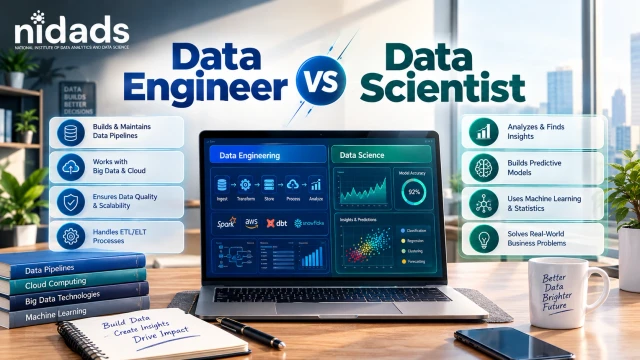
Table of contents
Data Engineer vs Data Scientist: Follow the Data-to-Decision Journey to See Where These Careers Truly Split
Forget the job titles for a second. Data engineers build the pipes. Data scientists figure out what's flowing through them and turn it into decisions. Engineers spend most of their day wrestling raw, messy data into something clean and dependable. Scientists take that clean version and dig into it, applying statistics and machine learning to answer questions the business is actually asking. Both jobs run on Python and SQL constantly, just not for the same reasons or to the same depth. Build versus understand, more or less.
Key Takeaways
•Infrastructure is the engineer's job. Analysis and modeling belong to the scientist.
• Python and SQL show up everywhere in both roles, just aimed at different goals.
• An engineer reaches for Spark, Kafka, and Airflow. A scientist reaches for pandas and scikit-learn.
• Pay lands in a similar range for both. Seniority matters more than the label on your business card.
• These are stages of one pipeline, not two teams competing for the same work.
What Is Data Engineer vs Data Scientist?
Definition
A data engineer designs the systems that collect, transform, store, and serve data at scale. A data scientist picks up that data and investigates it, using statistics and machine learning to answer business questions and build predictive models. Mapping out a structured route into the engineering side? This data engineer course and career path walks the journey step by step.
How It Works
Think relay race. Raw sources land with engineering first, get ingested, transformed, stored. Then data science takes the baton, explores it, models it, and what comes out the other end is the insight that actually moves a decision. Each side owns one leg. Drop the baton and neither leg matters much.
Why It Matters
Good decisions rest on good data, full stop. Skip solid engineering and even a great model is only as trustworthy as the mess feeding it. Build a flawless pipeline with nothing modeled on top of it, and you've got infrastructure going nowhere. Weighing this as a career move? This data science skills and career guide is worth a look for where the modeling side leads.
Why Is Data Engineer vs Data Scientist Important?
Clean pipelines and solid modeling, together, are what let a company actually trust its own data. Getting this split clear also saves beginners from trying to learn everything at once, and it keeps companies from quietly loading two jobs onto one person.
Data Engineer vs Data Scientist Explained
Responsibilities and Daily Workflow
Most days, engineers are buried in ingestion, ETL and ELT, orchestration, storage. Scientists are out exploring the data, building features, training models, checking whether any of it actually holds up. Same pipeline, opposite ends. The friction usually shows up right at the hand-off, when nobody's bothered to define who owns what.
Skills Overlap
Python and SQL are still common ground, plus Git and just enough cloud knowledge to function. Past that, engineers go deep on distributed systems, scientists go deep on statistics. Starting from zero? This Python and Data Science skills guide is a solid place to build that base.
Working Together
A churn-prediction project makes this concrete. Engineers hand off clean, usable customer data. Scientists turn it into a model that flags who's about to walk.
5 Best Skills to Build for Each Role
• SQL. Transformation work if you're an engineer, analysis if you're a scientist, either way you're not getting far without it.
• Python powers pipelines on one side and models on the other.
• Cloud platforms, AWS, Azure, GCP, handle storage and orchestration for engineers and training and deployment for scientists.
• Statistics isn't optional for a scientist, and it's genuinely useful for an engineer running quality checks.
• Distributed systems like Spark and Kafka are core to engineering and good background knowledge for any scientist working with big datasets.
The Data-to-Decision Architecture

Comparison Table
| Dimension | Data Engineer | Data Scientist |
| Primary Objective | Reliable infrastructure | Insight, models |
| Core Tools | Spark, Kafka, Airflow | pandas, scikit-learn, Jupyter |
| Statistics Depth | Light | Deep |
| Main Deliverable | Pipelines, clean tables | Models, predictions |
| 2026 Salary (US, base) | ~125K–156K | ~130K–173K |
Figures are drawn from Bureau of Labor Statistics data alongside Indeed and Glassdoor listings through 2026, and reflect base pay. They vary by city and experience, so treat them as a directional benchmark.
How to Choose Between Data Engineering and Data Science
SQL and Python first. You'll need both regardless of which way you go. Then run a small project on each side, a basic ETL script here, a basic prediction model there, and notice which one you actually enjoy. Once that lean is clear, push deeper: cloud and orchestration if it's engineering, statistics and modeling if it's science. Round it out with two or three portfolio projects and start applying for entry-level roles.
Real-World Example
An e-commerce company is pulling in clickstream and order data nonstop. The data engineer builds the pipeline keeping it clean and reliably stored. The data scientist takes that clean data and builds a churn model, flagging the customers most likely to leave so the retention team can step in.
Best Tools for Each Role
| Category | Data Engineer | Data Scientist |
| Processing | Apache Spark | pandas, NumPy |
| Orchestration | Apache Airflow | — |
| Streaming | Apache Kafka | — |
| Storage | Snowflake, BigQuery, Redshift | — |
| Modeling | — | scikit-learn, TensorFlow, PyTorch |
| Notebooks | — | Jupyter |
Career Applications
Finance, retail, healthcare, both roles show up wherever infrastructure and modeling have to work together. Fraud detection, recommendation engines, diagnostics, take your pick, none of it runs on just one side. Most industries need the pair.
Common Mistakes
• Reaching for tools before SQL and Python are actually solid.
• Assuming scientists can skip SQL, or engineers can skip Python.
• Collecting certifications instead of building anything real.
• Treating a job title as if it means the same thing at every company. It doesn't.
Data Engineer vs Data Scientist vs ML Engineer
Data engineers build the infrastructure that makes data reliable. Data scientists analyze it and build the models. ML engineers take those models and get them into production, deploying and monitoring at scale. No hierarchy here, just three people owning three different stretches of the same pipeline.
For a closer look at the tooling behind these workflows, the Apache Spark documentation covers how large-scale data processing actually runs in production.
Anyone weighing these career paths might also want to check current occupational outlook data from the Bureau of Labor Statistics before deciding.
Frequently Asked Questions
What is the difference between a data engineer and a data scientist?
Engineers build and maintain the infrastructure data lives in. Scientists analyze that data and build predictive models from it.
Which skills are required for data engineering?
SQL, Python, ETL and ELT, data modeling, cloud platforms, and orchestration tools like Airflow.
Which skills are required for data science?
Python, SQL, statistics, probability, and enough comfort with ML frameworks to actually use them.
Is data engineering harder than data science?
Not really. They're hard in different ways, one's about systems, the other's about statistical depth.
Does a data scientist need data engineering skills?
Some pipeline knowledge helps. Deep engineering expertise usually isn't required, though.
Can a data scientist become a data engineer, or vice versa?
Happens all the time, usually with some extra training to pick up whatever the other side demands.
What is the salary difference between a data engineer and a data scientist?
Pretty comparable in the US in 2026. Seniority and location matter more than the title.
What should a beginner learn first?
SQL and Python, hands down. Everything else builds on that.
Conclusion
This was never really about which job wins. It's about which stage of the data journey grabs you. Engineers build the systems that hold up under pressure. Scientists turn what those systems produce into decisions worth making. Both pay well in 2026. Both matter to any data team that's actually functioning. Learn the fundamentals, try a couple of small projects, then go where your interest actually pulls you.
About the Author
Quick facts
Name: Shagun
From: Delhi
Education: B.Tech
Program: Data Science and Data Analytics
Placed in: NIDADS (national institute of data science and analytics)
Covers topics: Data Science, Data Analytics, Artificial Intelligence, Machine Learning, Data Engineering, Deep Learning
Currently working as: Senior Data Science Trainer
In her words: "The best way to learn data science and engineer isn't just solving problems — it's understanding why the solution works. That's what I try to teach every single day."