8/13/2026
Machine LearningSupervised vs Unsupervised Learning: Who Guides AI?
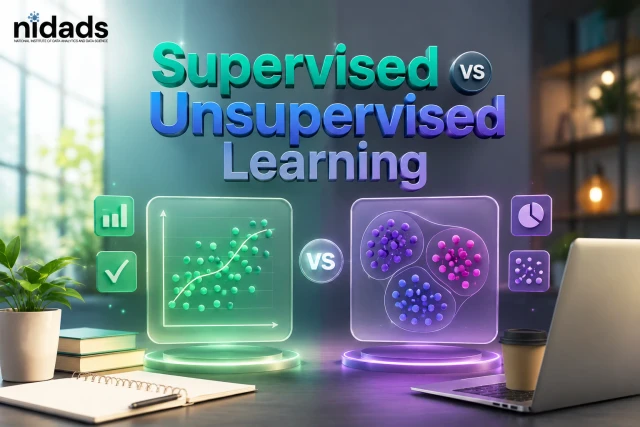
Table of contents
Supervised vs Unsupervised Learning: Discover What Happens When Machines Learn with Answers—or Search for Patterns on Their Own
Supervised learning trains a model on labeled data, so every training example already comes with the right answer, and the model learns to predict that answer for new inputs. Unsupervised learning gets no such help. It works with unlabeled data and has to find structure, groupings, or patterns with nothing to check its work against. Spam detection and price prediction are classic supervised problems, classification and regression. Customer segmentation and fraud-pattern discovery are classic unsupervised ones, clustering, dimensionality reduction, and anomaly detection.
Key Takeaways
- Supervised learning needs labeled data. Unsupervised doesn't.
- Classification and regression sit on the supervised side; clustering, dimensionality reduction, and anomaly detection sit on the unsupervised side.
- Supervised models get scored against accuracy, precision, recall, F1-score, or RMSE, since a known answer exists to compare against.
- Unsupervised models don't get that. They rely on indirect measures like the silhouette score, which shows how separated the clusters are, nothing more.
- Grand View Research pegs the global machine learning market at $55.8 billion in 2024, growing to $282.13 billion by 2030.
- Semi-supervised learning stretches a small labeled dataset across a much larger unlabeled one to keep labeling costs down.
- Self-supervised learning is a bit different. It generates its own training targets from the data's structure, and it's what most large language models are built on.
- Skip feature scaling before running K-means and you'll regret it. Unsupervised algorithms are especially sensitive to features with larger numeric ranges quietly taking over the distance math.
What Is Supervised Learning?
Each record in a supervised dataset already carries the right answer. A model built to predict loan default risk, for instance, trains on historical records where every applicant's outcome, default or repay, is already known. During training it compares its guess to that real label, works out the error, and nudges its parameters to shrink it. Rinse and repeat until performance on a validation set stops improving. Most structured machine learning courses cover this labeled-data workflow before touching specific algorithms, and for good reason: everything else builds on it. Skip this foundation and concepts like overfitting, cross-validation, and regularization won't make much sense later, since they're all just different ways of managing that same error-reduction process.
What Is Unsupervised Learning?
No labels here at all. The model gets raw records, customer transactions, sensor readings, text documents, and has to find structure on its own, without anyone telling it what to look for. Clustering groups similar records together. Dimensionality reduction squeezes correlated features into fewer components. Anomaly detection flags whatever doesn't fit the pattern. There's a catch, though: since there's no answer key, a human still has to look at whatever comes out and decide if it's actually useful. Mathematically clean clusters that mean nothing in business terms happen more often than you'd think, which is why domain validation isn't optional here, it's the whole point. A retail team might cluster shoppers into five neat-looking groups only to discover none of them map to anything the marketing team can actually act on, and that gap between statistical tidiness and real usefulness is the main risk with this whole approach.
Supervised vs Unsupervised Learning: Core Comparison
| Factor | Supervised Learning | Unsupervised Learning |
| Data type | Labeled | Unlabeled |
| Objective | Predict a known target | Discover hidden structure |
| Common tasks | Classification, regression | Clustering, dimensionality reduction |
| Common algorithms | Linear/logistic regression, random forest, gradient boosting | K-means, hierarchical clustering, DBSCAN, PCA |
| Evaluation method | Accuracy, precision, recall, RMSE | Silhouette score, visual inspection |
| Output | Predicted value or class | Groups, reduced features, or flagged outliers |
| Labeling cost | High, needs labeled examples | None required |
Which Approach Should You Use?
Start with one question: does a target variable already exist in the data? Recorded outcomes, fraud or not fraud, churn or retained, point straight to supervised learning. No target and a pile of unlabeled records to explore instead? That's unsupervised territory. Both live under the exact same machine learning roof, and AI vs Machine Learning vs Deep Learning maps out how the pieces fit together.
There's a middle path worth knowing about too. Labeling a subset of the data and training a supervised model often works better than forcing an unsupervised method to answer a question that already has a known target, and combining both is common in practice: cluster first to generate segment groups, then train a classifier on top to sort new records into those same segments automatically.
Data Interpretation: Supervised vs Unsupervised
The diagram below traces the same raw dataset through two different paths depending on whether labels exist, and shows how that single fork changes the output entirely: a prediction on one side, a discovered grouping on the other.
 Data-to-Approach Selection Matrix
| Data Pattern | Recommended Approach | Reasoning |
| Historical records with known outcomes | Supervised learning | Ground truth exists for training and evaluation |
| Unlabeled transaction or behavior data | Unsupervised (clustering) | Structure must be discovered before labeling |
| High-dimensional data | Unsupervised (dimensionality reduction) | Reduces feature count while preserving structure |
| Rare-event detection, few labeled cases | Unsupervised anomaly detection or semi-supervised | Too few positive labels for reliable supervised training |
| Small labeled set, large unlabeled pool | Semi-supervised learning | Extends limited labels using unlabeled data structure |
Common Mistakes
Accuracy alone on imbalanced data is the classic trap. A fraud model that predicts "legitimate" every single time can still post 99% accuracy while missing every real case. Feature scaling gets skipped a lot too, and distance-based algorithms like K-means or KNN will let larger-range features quietly dominate the outcome when that happens. Some teams also assume any unlabeled dataset belongs in unsupervised learning by default, when labeling a smaller slice of it would sometimes get better results with a supervised model instead.
Clustering output gets trusted without domain checks more often than it should, given that clustering algorithms will always produce groups whether or not those groups mean anything real. Data leakage is another one worth watching for; letting information into training that wouldn't exist at prediction time inflates test scores in ways that fall apart in production. And plenty of teams reach for a complex algorithm before building a simple baseline first, even though that baseline is the only real way to know whether the added complexity paid off. A data engineer curriculum walks through the cleaning, feature engineering, and validation work behind both learning types, and honestly, most of the "mistakes" above trace back to skipping one of those unglamorous steps.
About NIDADS
NIDADS runs project-based courses in data science, analytics, and AI, built for people who want job-ready skills rather than theory alone. This piece belongs to a series that explains core machine learning ideas the way a good instructor would in class: straight to the point, backed by real examples. Memorizing definitions was never the goal. Knowing which approach fits a given dataset before you even open a notebook is.
Further Reading
Grand View Research tracks the machine learning market forecast, including the $55.8 billion (2024) to $282.13 billion (2030) growth figure cited above. IBM runs a solid technical comparison of supervised and unsupervised methods. Scikit-learn's documentation covers implementation details for both categories of algorithms.
Conclusion
Supervised learning needs labeled data and predicts a known target, judged by metrics like accuracy or RMSE. Unsupervised learning works without labels and uncovers structure through clustering or dimensionality reduction, judged indirectly through things like the silhouette score. Whether a target variable already exists in the dataset decides which one to reach for. Semi-supervised and self-supervised methods stretch both approaches further when labeled data runs thin. Pick the right learning type before picking the model, since that one decision still shapes a project's final outcome more than anything downstream.
Frequently Asked Questions
Is clustering supervised or unsupervised?
Unsupervised. No predefined labels involved.
Is regression a supervised learning method?
Yes, it predicts a continuous value from labeled data.
Is K-Means supervised or unsupervised?
Unsupervised, it groups data purely by distance to cluster centers.
Which evaluation metric works for unsupervised models?
Mostly the silhouette score. It shows cluster separation but says nothing about real-world meaning.
Can supervised and unsupervised learning be combined?
Often, yes. Cluster first, then train a supervised classifier to predict cluster membership for new records.
What is semi-supervised learning?
A small labeled dataset paired with a much larger unlabeled one, mainly to save on labeling cost.
What is self-supervised learning?
The model builds its own training targets from the data's structure. Most large language models rely on it.
How much labeled data does supervised learning need?
Depends entirely on the task. Harder problems need more, though transfer learning can lower that bar.
About the Author
Quick facts
Name: Shagun
From: Delhi
Education: B.Tech
Program: Data Science and Data Analytics
Placed in: NIDADS (National Institute of Data Analytics & Data Science)
Covers topics: Data Science, Data Analytics, Artificial Intelligence, Machine Learning, Data Engineering, Deep Learning
Currently working as: Senior Data Science Trainer
In her words: "The best way to learn data science isn't just solving problems — it's understanding why the solution works. That's what I try to teach every single day."