8/11/2026
Machine LearningAI vs Machine Learning vs Deep Learning: Intelligence Decoded
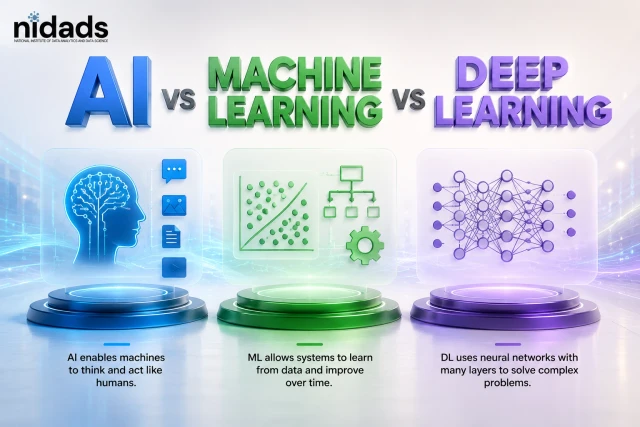
Table of contents
AI vs Machine Learning vs Deep Learning: Decode the Complete Intelligence Hierarchy Behind ChatGPT, Generative AI, Neural Networks and Tomorrow's Intelligent Systems
AI, Machine Learning, and Deep Learning aren't three separate technologies fighting for the same job. They're layers, one sitting inside the next. AI is the broad goal: get a machine to act intelligently. Machine Learning is the slice of AI that learns from data rather than following fixed rules. Deep Learning is the slice of Machine Learning that uses stacked neural networks to learn straight from raw data — images, audio, text. Most of the confusion here comes from treating these as three competing options instead of one hierarchy.
Key Takeaways
● AI is the umbrella term. ML and Deep Learning live inside it.
● Not every AI system uses Machine Learning. Not every ML model counts as Deep Learning either.
● Deep Learning is the fastest-growing slice of the AI market right now — generative AI is most of the reason why.
● Classical ML still beats Deep Learning on small, structured, spreadsheet-style data.
● Python and statistics travel with you across all three.
What Actually Separates AI, ML, and Deep Learning
Think of three circles, one inside the other. Simple as that, really. The outer, biggest one is Artificial Intelligence — the overall goal of getting a machine to behave intelligently, however it gets there. Inside that sits Machine Learning, where the system works out its own behaviour from data instead of being told exactly what to do. And inside Machine Learning sits Deep Learning, which uses stacked layers of artificial neurons to pull patterns straight out of raw data.
That last part is really the dividing line. In classical Machine Learning, someone still decides what matters — income, credit history, existing debt, for a loan-default model. In Deep Learning, that step mostly disappears. Feed a neural network raw pixels and its early layers pick out edges on their own. The next layers combine those edges into shapes. Deeper layers combine shapes into something recognisable. Nobody wrote code for that; the network worked it out from examples.
Numbers back this up. Deep learning was the biggest revenue-generating slice of the global AI market in 2025, and the overall AI market is on track for roughly $539.5 billion in 2026, growing over 30% a year, per Grand View Research. Machine learning on its own sits closer to $105 billion today, expected to pass $560 billion by 2031. That gap says something — Deep Learning keeps eating a bigger share of AI spending because it's the engine behind most generative AI tools people actually touch day to day.
A rule-based chess engine from the 1990s counts as AI, but not ML — it evaluates moves with fixed logic, never learning from data. A spam filter trained on labelled emails is AI and ML, but probably not Deep Learning, likely running something closer to logistic regression. A modern transformer-based chatbot is all three at once.
Visual: How AI, ML, and Deep Learning Nest Together
 Comparison at a Glance
Here's the short version, side by side.
| Factor | Artificial Intelligence | Machine Learning | Deep Learning |
| What it is | Broad goal of intelligent behaviour | Learns patterns from data | Learns patterns via layered neural networks |
| Feature selection | N/A or manual | Usually manual | Largely automatic |
| Data needed | Varies by approach | Works with smaller, structured sets | Often benefits from large datasets, though transfer learning reduces this |
| Hardware | CPU is usually fine | CPU is usually fine | GPUs/TPUs common at scale; smaller models can run on CPU |
| Explainability | Depends on approach | Often fairly transparent | Frequently harder to interpret |
| Typical example | Rule-based chess engine | Credit scoring, fraud flags | Image recognition, transformer models |
Machine Learning still holds its ground where Deep Learning doesn't make much sense — tabular data with a few thousand rows. Training a neural network there is usually overkill. A decision tree or gradient-boosted model often matches its accuracy in a fraction of the time, and you can actually explain the result to a compliance officer.
Across industries, there's a fairly consistent split. AI and classical ML handle scoring, forecasting, and rule-based routing: patient risk scoring, credit scoring, demand forecasting, predictive maintenance, call routing. Deep Learning takes over once the input turns messy and unstructured — X-rays and MRIs, fraud patterns in transaction sequences, visual search, real-time object detection for self-driving cars, visual defects on a production line. Healthcare is worth watching: the AI-in-healthcare market is on a path from roughly $25.9 billion in 2025 to nearly $195 billion by 2031, and deep learning's ability to read scans faster than manual review is a big part of why.
Which One Should You Learn in 2026?
Skip the philosophy for a second. Here's what to actually study, based on where you want to end up.
| Your Goal | Start With |
| Data Analyst | Python, Statistics, SQL |
| Data Scientist | Python, Statistics, Machine Learning |
| ML Engineer | Python, Machine Learning, MLOps |
| GenAI Engineer | Machine Learning, Deep Learning, Transformers |
| Computer Vision | Deep Learning, CNNs |
| NLP | Deep Learning, Transformers |
This decision tree probably matters more than a generic "AI vs ML vs DL" explanation, because most people aren't picking a field in the abstract. They're deciding where to spend six months of study time.
Common Mistakes People Make Comparing AI, ML, and DL
A few habits trip people up here more than anything. Biggest one: assuming Deep Learning always wins. On small, structured datasets, a well-tuned decision tree often beats it on speed and accuracy. Close behind: treating "AI" and "Machine Learning" as interchangeable in job postings or pitches — recruiters notice when someone can't tell the two apart.
Compute cost gets ignored a lot too. A Deep Learning model needing a GPU cluster for weeks isn't automatically the better choice if a lighter ML model already gets 95% of the accuracy overnight. There's also a habit of assuming every AI headline is about generative AI, when plenty of production systems in banking and logistics are still rule-based or classical ML, by design. Last one: skipping interpretability. In regulated industries, a model nobody can explain is often more liability than asset.
How to Decide Which One You Actually Need
Start with your data, not the trend — that's really the whole trick. Structured, tabular data points toward classical Machine Learning. Unstructured data — images, audio, free text — points toward Deep Learning. Not sure which layer fits your goals? A artificial intelligence course is a reasonable place to begin, since it usually walks through where each layer fits before asking you to specialise.
Be honest about your data volume, and weigh compute cost against what you're trying to achieve. GPU time isn't free. If you already know you want to build models rather than just use them, a machine learning course covers the statistics and modelling groundwork both ML and DL sit on top of.
Weigh explainability against raw performance too — if someone needs to know why a decision got made, lean toward interpretable ML. Interested in building the pipelines that feed these models, rather than the models themselves? A data engineer covers the infrastructure layer everything else depends on. Before committing to a path, build one small project — a spam classifier or a basic image classifier teaches more than any roadmap, this article included.
Conclusion
Not really a contest, when you get down to it. It's about matching the right level of complexity to your actual problem. AI is the destination. Machine Learning is the most common road there, learning from data instead of hand-written rules. Deep Learning is the specialised lane built for messy, unstructured data that classical algorithms struggle with. Tabular data, modest size? Machine Learning will probably serve you better and cheaper. Images, audio, or language at scale? Deep Learning is doing the heavy lifting behind most of the impressive AI you're using right now.
Want the deeper numbers? Grand View Research's AI market report and MarketsandMarkets' healthcare AI coverage both publish updated data, worth checking directly rather than taking any single article's word for it.
Frequently Asked Questions
Is Deep Learning just a fancier name for Machine Learning?
No — it's a subset of Machine Learning using multi-layered neural networks. All Deep Learning is Machine Learning, but most Machine Learning isn't Deep Learning.
Do I need to learn Machine Learning before Deep Learning?
Pretty much, yes. Overfitting, train/test splits, evaluation metrics — all of that underpins both, and it's just easier to grasp with simpler ML models first.
Can AI exist without any Machine Learning at all?
It can. Rule-based expert systems and search algorithms count as AI, no data-driven learning involved.
Is ChatGPT AI, ML, or Deep Learning?
Honestly, all three. It's an AI system, built with Machine Learning, specifically through a Deep Learning transformer architecture.
Which one is easier for a beginner to start with?
Machine Learning, usually. Less advanced math, smaller datasets, and you get a working result faster than training a neural network from scratch.
Does Deep Learning always need a GPU?
Beyond toy datasets, effectively yes — though cloud GPU services have made this a lot more accessible without owning hardware.
What is the fastest-growing segment of the AI market right now?
Deep Learning. It's the engine behind the current generative AI boom — chatbots, image generation, voice systems.
Is Machine Learning still relevant if Deep Learning exists?
Very much. On small, structured, spreadsheet-style datasets, classical ML tends to be cheaper, faster to train, and easier to explain.
About the Author
Quick facts
Name: Shagun
From: Delhi
Education: B.Tech
Program: Data Science and Data Analytics
Placed in: NIDADS (National Institute of Data Analytics & Data Science)
Covers topics: Data Science, Data Analytics, Artificial Intelligence, Machine Learning, Data Engineering, Deep Learning
Currently working as: Senior Data Science Trainer
In her words: "The best way to learn data science isn't just solving problems — it's understanding why the solution works. That's what I try to teach every single day."