7/30/2026
Machine LearningMLOPS Course: Turn ML Models into Production AI
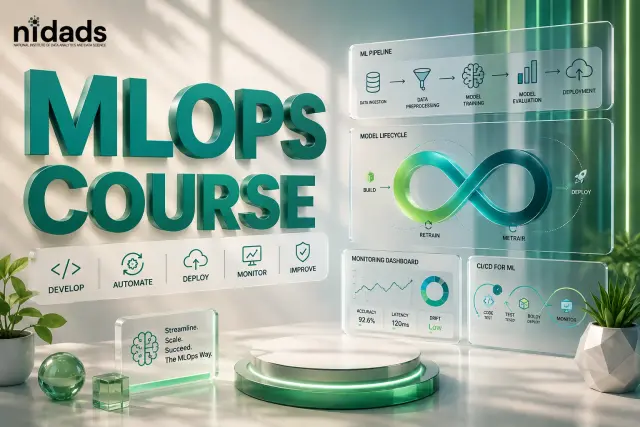
Table of contents
MLOPS Course: Build, Deploy and Scale Production AI Systems
An MLOps course teaches the skills to deploy, scale, and monitor machine learning models in production using Docker, Kubernetes, MLflow, and CI/CD pipelines. The global MLOps market is projected to grow from USD 3.33 billion in 2026 to USD 56.60 billion by 2035, a 37% CAGR. MLOps Engineers earn an average of ₹16.5 LPA in India and $161,411 per year in the US. Graduates qualify for MLOps Engineer, ML Platform Engineer, and AI Infrastructure Engineer roles.
Key Takeaways
• The global MLOps market is projected to grow at a 37% CAGR, from $3.33B in 2026 to $56.60B by 2035.
• Core tools taught include Docker, Kubernetes, MLflow, Kubeflow, Apache Airflow, and one major cloud platform.
• Indian salaries range from ₹6 LPA at entry level to ₹35+ LPA at senior level; US salaries range from $87,000 to $240,000+.
• 55% of companies cite inadequate MLOps practices as a major obstacle to production machine learning.
• Software and ML infrastructure roles are projected to grow 15% through 2034, far above the 3% average for all occupations.
• BFSI holds roughly 28% of MLOps market share, the largest of any industry vertical.
What Is an MLOPS Course?
An MLOps course is a structured training program covering Machine Learning Operations: applying DevOps principles such as automation, testing, monitoring, and version control to the machine learning lifecycle. It covers packaging, deploying, scaling, and monitoring models reliably in production rather than only building them. A 2025 systematic review found that 55% of companies cite inadequate MLOps practices as a major obstacle to deployment, while 70% of organizations are actively investing in MLOps tools. Most courses combine software engineering, cloud infrastructure, ML-specific tooling, and workflow orchestration. Learners are typically job-ready within 4 to 8 months, depending on prior DevOps or ML experience. Python is the primary language used; a computer science degree is not mandatory.
Why Learn an MLOPS Course in 2026?
• The global MLOps market is projected to grow from $2.43B in 2025 to $56.60B by 2035 at a 37% CAGR.
• BFSI holds the largest end-user market share at roughly 28%; healthcare is the fastest-growing vertical.
• Employment for software developers, QA analysts, and testers is projected to grow 15% through 2034.
• The average US MLOps Engineer salary of $161,411 exceeds the broader software developer median of roughly $130,000.
• Cloud deployments account for roughly 55% of new MLOps platform rollouts.
• Many MLOps roles are remote-friendly since the work centers on cloud infrastructure.
Skills You Learn in an MLOPS Course
Core skills include designing reproducible ML pipelines from data ingestion to model serving; Docker for containerizing models with exact dependencies; Kubernetes for orchestration, auto-scaling, and failure recovery; MLflow for experiment tracking, versioning, and a model registry; Kubeflow for orchestrating multi-step pipelines on Kubernetes; CI/CD for automatically testing and shipping model versions; deployment patterns including batch inference, real-time endpoints, canary releases, and blue-green rollout; model monitoring for prediction quality, data drift, and concept drift; and hands-on work with AWS SageMaker, Google Vertex AI, or Azure Machine Learning, since most production ML pipelines run on cloud infrastructure.
MLOps sits at the intersection of Machine Learning, DevOps, Data Engineering, and Cloud Computing. It borrows automation and CI/CD practices from DevOps, data pipeline discipline from Data Engineering, and scalable infrastructure from Cloud Computing, applying all three to the ML model lifecycle.
Learners comparing this path often also explore a machine learning course to strengthen model-building fundamentals, or review the Data Engineer Course and Data Science Course for adjacent specializations before choosing a final track.
MLOPS Engineer vs DEVOPS Engineer vs Machine Learning Engineer
| Factor | MLOPS Engineer | DEVOPS Engineer | ML Engineer |
| Primary Focus | Deploying & monitoring ML models | Software delivery automation | Building & training models |
| Core Tools | Docker, Kubernetes, MLflow | Jenkins, Terraform, Ansible | Python, PyTorch, Pandas |
| Coding Required | Moderate-High | Moderate | High |
| India Salary (Entry) | ₹6-10 LPA | ₹5-9 LPA | ₹8-18 LPA |
| India Salary (Mid) | ₹12-20 LPA | ₹10-16 LPA | ₹18-40 LPA |
| US Salary (Avg) | $130,000-$165,000 | $110,000-$150,000 | $140,000-$180,000 |
| Best Entry Cert | AWS ML Specialty, CKA | AWS/Azure DevOps Associate | Google Professional ML Engineer |
MLOPS Course Syllabus
A typical syllabus covers: Python and ML fundamentals; Git and version control for code, data, and models using DVC; Docker and containerization; CI/CD pipelines with Jenkins or GitHub Actions; workflow orchestration with Apache Airflow or Kubeflow; experiment tracking with MLflow; Kubernetes for scalable deployment; cloud-specific ML services; model monitoring and observability; and a capstone project covering the full pipeline from data to a deployed, monitored model.
MLOPS Certifications
Recognized certifications include AWS Certified Machine Learning - Specialty, Google Professional Machine Learning Engineer, Microsoft Certified: Azure AI Engineer Associate, Certified Kubernetes Administrator, and Databricks Certified Machine Learning Associate. A certification strengthens a resume when paired with real deployment projects; employers consistently rank hands-on capstone work above certification badges alone.
Placement Support and Project Evidence
Structured MLOps programs document placement outcomes, maintain verifiable GitHub portfolios, and require a capstone project covering containerization, CI/CD, and monitoring - typically a Dockerized model API, a CI/CD retraining pipeline, and a Kubernetes deployment with drift monitoring. Mock interviews cover system design and pipeline debugging; resumes are optimized with keyword mapping for applicant tracking systems.
Career and Salary After an MLOPS Course
• MLOps Engineer: ₹6-35 LPA in India, $87,000-$240,000 in the US.
• Senior MLOps/ML Platform Engineer: ₹20-40 LPA in India, $170,000-$315,000 in the US.
• Machine Learning Engineer: ₹8-40 LPA in India, $140,000-$180,000 in the US.
• AI Infrastructure Engineer: ₹10-30 LPA in India, $130,000-$200,000 in the US.
Figures vary by city and company.
Industries Hiring MLOPS Engineers
BFSI leads adoption with real-time fraud detection and regulatory compliance needs. Healthcare uses MLOps for diagnostic model monitoring; retail and e-commerce for recommendation engines; manufacturing for predictive maintenance. Other active sectors include autonomous vehicles, cybersecurity, telecommunications, logistics, and government.
Learning Roadmap
 Common Mistakes Beginners Make
Learning only model-building while skipping deployment; ignoring version control for data and models, not just code; treating monitoring as optional; choosing a course with no hands-on cloud labs; and not building a public portfolio of deployed models.
Future Scope of MLOPS
MLOps is expanding into LLMOps, which applies similar principles to large language models and AI agents, adding prompt versioning, agent evaluation, and inference cost management. Related growth areas include AI observability, model governance, and responsible AI practices.
For official data on employment growth and market size, see the U.S. Bureau of Labor Statistics Occupational Outlook for Software Developers and the Precedence Research MLOps Market report.
Conclusion
An MLOps course builds employment-ready skills in Docker, Kubernetes, MLflow, CI/CD, and cloud deployment. The global MLOps market is projected to reach $56.60 billion by 2035, and related infrastructure roles are projected to grow 15% through 2034. Entry-level salaries start at ₹6-10 LPA in India and $87,000-$130,000 in the US, with progression tied to cloud certification and deployment experience. Select a program with a verified curriculum, real deployment projects, and documented placement outcomes.
Frequently Asked Questions
Is coding required for an MLOps course?
Yes. Python is the primary language used across MLOps tooling, along with YAML for pipeline configuration and Bash for automation scripting.
What is the duration of an MLOps course?
Most focused programs take 4 to 8 months, depending on prior DevOps or ML experience; learners with existing Docker or cloud exposure often finish faster.
Which certification is most valued by employers?
AWS Certified Machine Learning - Specialty and Google Professional Machine Learning Engineer are the most in-demand for cloud-based roles; Certified Kubernetes Administrator is valued for orchestration-heavy positions and platform teams.
What salary does a fresher earn after an MLOps course?
Entry-level salaries in India typically range from ₹6-10 LPA; in the US, entry-level roles start around $87,000-$130,000, rising with cloud certification and deployment experience.
Is MLOps a good career in 2026?
Yes. The global market is projected to grow at a 37% CAGR through 2035, and related software and infrastructure roles are projected to grow 15% through 2034, well above the 3% average for all occupations.
Which programming language is used most in MLOps?
Python dominates MLOps tooling, supported by YAML for configuration and Bash for scripting; most orchestration and tracking tools such as MLflow and Airflow expose Python-first APIs.
About the Author
Quick facts
Name: Shagun
From: Delhi
Education: B.Tech
Program: Data Science and Data Analytics
Placed in: NIDADS (National Institute of Data Analytics & Data Science)
Covers topics: Data Science, Data Analytics, Artificial Intelligence, Machine Learning, Data Engineering, Deep Learning
Currently working as: Senior Data Science Trainer
In her words: "The best way to learn data science isn't just solving problems — it's understanding why the solution works. That's what I try to teach every single day."