5/31/2026
Data AnalyticsHow Digital Marketers in India Are Using Data Analytics to Get Better Results
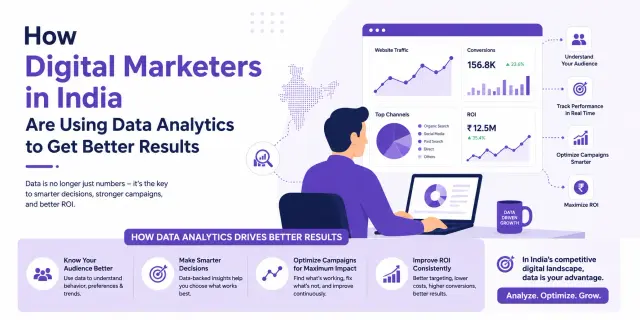
Table of contents
Table of Contents
- Quick Answer
- Why Data Analytics in Digital Marketing Matters for Indian Brands
- 4 Ways Indian Marketers Are Using Data Analytics Right Now
- Top Tools for Data Analytics in Digital Marketing — India Edition
- Step-by-Step: Build Your First Analytics Workflow
- Real Case Study: Delhi D2C Brand Drops CAC by 40%
- FAQ
- The Bottom Line
- SEO Notes
Quick Answer
TL;DR: Data analytics in digital marketing helps Indian marketers identify which campaigns generate real ROI, which audiences convert, and where budget is being wasted. Teams using structured analytics workflows — with tools like GA4, Meta Ads Manager, and CleverTap — typically reduce cost-per-lead by 30–50% within 90 days. You don't need a data science background to start.
Why Data Analytics in Digital Marketing Matters for Indian Brands
Indian digital ad spend crossed ₹50,000 crore in 2024, according to the IAMAI-Kantar Report. Every rupee of that is competing for the same consumer's attention. The brands winning aren't outspending everyone — they're outwitting them with better data.
Data analytics in digital marketing gives you visibility that gut feel simply can't. You stop guessing which ₹100 of ad spend is working. You know.
Most Indian marketing teams still run campaigns on instinct — checking results weekly, optimising based on whoever speaks loudest in the meeting. The shift to evidence-based decision-making isn't just a trend. It's now the baseline for competitive performance.
4 Ways Indian Marketers Are Using Data Analytics Right Now
1. Audience Segmentation That Actually Converts
Sending the same message to every user wastes budget and hurts relevance scores. Data analytics in digital marketing lets you split audiences by real behavior — people who visited your pricing page three times without buying, customers who bought once six months ago, users who clicked but bounced in under 10 seconds.
Each group needs a different message. GA4 and Meta Custom Audiences handle this for free. According to HubSpot's 2024 State of Marketing Report, segmented email campaigns generate 760% more revenue per email than unsegmented ones.
2. Attribution Modelling — Stop Crediting the Wrong Channel
Most Indian marketing teams default to last-click attribution. That means a customer who found you through a blog post, saw your YouTube ad twice, then converted via Google Search — gives 100% credit to Search. The blog and YouTube look worthless. You cut them. Results slowly fall apart.
Multi-touch attribution shows how each touchpoint actually contributed. Google Analytics 4 now uses data-driven attribution as its default. Switching to it is often the single highest-ROI change a team can make. We've seen brands reallocate ₹2–3 lakhs of monthly budget more accurately — just by fixing attribution. data analytics course with placement
3. Real-Time Campaign Monitoring
A ₹5 lakh campaign running for 30 days with weekly check-ins is a gamble. Real-time data analytics in digital marketing catches problems on day 2, not week 4.
One team we worked with found their Facebook ads targeting Mumbai were pulling in Tier-3 traffic with zero purchase intent. Caught early, they fixed targeting and saved ₹80,000. Without daily monitoring, that runs the full month.
4. Customer Lifetime Value (CLV) Optimisation
Acquiring a new customer in Indian e-commerce costs 5–7x more than retaining one, per Netcore Cloud's 2024 data. Yet most brands pour 80% of their budget into acquisition.
CLV analytics tells you which channels bring your highest-value customers — not just the most customers. Brands like Mamaearth and boAt have made this a growth pillar. It's why they scale efficiently while smaller brands burn through budgets chasing volume.
Top Tools for Data Analytics in Digital Marketing — India Edition
Tool
Best For
Cost
India Fit
Google Analytics 4
Website & conversion tracking
Free
Excellent
Meta Ads Manager
Facebook/Instagram performance
Free
Excellent
CleverTap
App retention & push automation
From ₹15,000/mo
Strong for D2C
WebEngage
Lifecycle & cross-channel marketing
Custom pricing
Popular in fintech/e-com
Zoho Analytics
Custom dashboards, BI reports
From ₹1,000/mo
Best for SMEs
Google Looker Studio
Free visual dashboarding
Free
Widely used
Step-by-Step: Build Your First Analytics Workflow
Step 1 — Pick your North Star metric. Choose the one number that defines success right now: ROAS for e-commerce, CPL for lead generation, MQL-to-SQL rate for SaaS. Everything else gives context to that number.
Step 2 — Audit your tracking. Check that GA4 conversion events are firing correctly — purchases, form fills, clicks to call. Bad data in means bad decisions out. This single step fixes more problems than any new tool will. big data analytics
Step 3 — Build one weekly dashboard. Use Looker Studio to display 5–7 key metrics. Share it with your team every Monday. Data accountability starts with everyone looking at the same numbers.
Step 4 — Run one A/B test per month. Test one variable — a subject line, a landing page headline, an ad creative. Wait for at least 100 conversions per variant before reading results. Over 12 months, this produces 12 validated improvements that compound.
Step 5 — Review cohorts quarterly. Which month's customer cohort retained the longest? Which channel produced them? Shift more budget there next quarter. This is data analytics in digital marketing working as a self-improving system.
Learn Data analytics in digital marketing course
Real Case Study: Delhi D2C Brand Drops CAC by 40%
Brand: Delhi-based skincare D2C, ₹12 lakh/month ad budget across Meta, Google, and influencers.
Problem: CAC had climbed from ₹380 to ₹620 over 8 months. No one knew why.
What the data revealed:
- Last-click attribution was over-crediting Google Search and starving Meta remarketing — which was actually closing most sales
- 38% of ad spend targeted segments with under 5% repeat purchase history
- Their top creative had been running 7 months; ad fatigue had halved its CTR, unnoticed
What changed: Switched to GA4 data-driven attribution. Rebuilt Meta audiences around high-CLV lookalikes. Refreshed creatives. Cut ₹4.8 lakhs in confirmed dead spend. Google Analytics 4
Result in 90 days: CAC fell from ₹620 to ₹370. ROAS jumped from 2.1x to 3.8x. Conversions went up despite a smaller budget.
Data analytics in digital marketing didn't change the product. It stopped the bleeding.
FAQ
What is data analytics in digital marketing?
It's the process of collecting and interpreting campaign and customer data to make better marketing decisions. This includes tracking ad performance, analysing website behaviour, measuring ROI, and using insights to optimise future campaigns. In short — it replaces guesswork with evidence.
How does data analytics improve digital marketing ROI in India?
By showing exactly which channels, creatives, and audience segments drive real conversions — and which waste budget. Indian brands implementing structured data analytics in digital marketing typically see CAC drop 25–45% within 60–90 days, simply by stopping misallocated spend.
Which tools are best for marketing data analytics in India?
For most teams: Google Analytics 4 (free, excellent), Meta Ads Manager (free), and Google Looker Studio for dashboards. For D2C brands needing retention marketing: CleverTap or WebEngage. For affordable BI: Zoho Analytics from ₹1,000/month.
Do I need a technical background to use data analytics in digital marketing?
No. Start with GA4 and one Looker Studio dashboard. Spend 30 minutes weekly reviewing your core metrics. You'll spot patterns within 4–6 weeks. Analytical thinking matters far more than technical skills.
Is data analytics useful for small businesses and startups in India?
Absolutely — arguably more so. When every rupee counts, knowing what's working is critical. Most essential tools are free. A ₹50,000/month budget managed with solid analytics will consistently outperform a ₹5 lakh budget run on instinct.
What's the difference between web analytics and marketing analytics?
Web analytics tracks what happens on your website — sessions, bounce rates, page views. Marketing analytics is broader — it measures performance across all channels (ads, email, SEO, social) and ties activity to revenue outcomes. Web analytics feeds into marketing analytics, not the other way around.
The Bottom Line
Data analytics in digital marketing isn't a tool — it's a decision-making habit. Indian marketers who've made the shift report lower CAC, better ROAS, and campaigns that actually improve over time instead of slowly eroding.
Start with your tracking. Build one dashboard. Run one test. The compounding effect is real — and it starts on day one.
Want a data analytics setup that your team will actually use? At DigitalAdda, we help Indian brands and agencies build analytics workflows, fix attribution, and turn raw data into decisions.
About the Author
Quick facts
Name: Shagun
From: Delhi
Education: B.Tech
Program: Data Science and Data Analytics
Placed in: NIDADS (National Institute of Data Analytics & Data Science)
Covers topics: Data Science, Data Analytics, Artificial Intelligence, Machine Learning, Data Engineering, Deep Learning
Currently working as: Senior Data Science Trainer
In her words: "The best way to learn data science isn't just solving problems — it's understanding why the solution works. That's what I try to teach every single day."