11/27/2026
Bias Variance Tradeoff: Find the Model's Sweet Spot
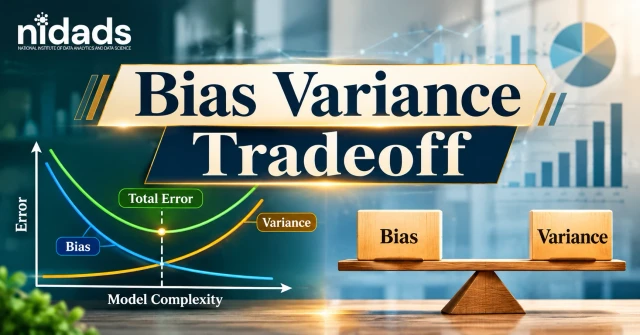
Table of contents
Bias Variance Tradeoff: How to Diagnose Underfitting and Overfitting and Find the Model Complexity That Generalizes Best
A model can go wrong in two ways, and the bias-variance tradeoff is about telling them apart. Bias is the error you get when your assumptions are too simple. Variance is the error you get when the model clings too tightly to the exact data it saw during training. Simple models drift toward high bias. Flexible ones drift toward high variance. What you want is the middle ground, where predictions still hold up on data the model has never seen.
Key Takeaways
- Bias means the model is too simple, so it misses the real pattern.
- Variance means the model changes a lot every time the training data changes.
- High bias usually shows up as underfitting. High variance usually shows up as overfitting.
- Validation data, not training data, tells you which problem you’re actually facing.
- Chase the lowest error on unseen data. Zero error isn’t the goal.
What is Bias Variance Tradeoff
Bias is the average error caused by wrong assumptions. Variance is how far predictions swing when the training data changes. Irreducible error is random noise that no model can remove.
Let’s put that in everyday terms. Bias is a steady miss in one direction, like a kitchen scale that always reads two kilos heavy. Variance is a miss that wanders, landing somewhere different with each new sample. Irreducible error is just bad luck built into the data, a sensor glitch or a typo in a record, for instance.
Simple and Technical Explanation
A model can fail by being too rigid or too jumpy.
Picture predicting house prices. Say you guess the average price for every single house. That’s too rigid, and it’s high bias. Now say you memorize every past sale, even the strange ones. That’s too jumpy, and it’s high variance. It looks flawless on old houses, then stumbles the moment a new one shows up.
Technical view (squared-error loss): Expected error = bias² + variance + irreducible noise. This holds when the target is a true function plus zero-mean noise. Other loss functions split up differently, so use the formula as a guide rather than a law that fits every model.
How It Works
More complexity usually lowers bias and raises variance, up to a point.
As a model grows more complex, training error keeps falling. Validation error falls too, at first. Then it bottoms out and starts climbing. That bottom is your sweet spot, and it sits in a different place for every dataset. One caution: complexity doesn’t automatically mean high variance. Regularization and extra data can change the picture. If you’d like the math behind all this, start with the statistical concepts behind the bias-variance tradeoff and come back.
Step-by-Step Diagnosis
Compare errors in a fixed order, so you don’t end up fixing the wrong problem.
- Split your data into training, validation and test sets.
- Train a simple baseline model first.
- Record both the training error and the validation error.
- Plot a learning curve (error versus training size).
- Change one thing at a time: complexity, features or regularization.
- Pick whichever setup gives the best validation result, and open the test set only once.
It also helps to understand machine learning model evaluation well, because every step above depends on how you measure error.
Practical Example (Real Run)
A model that’s too simple and a model that’s too flexible both lose on new data.
I ran polynomial models on 120 synthetic points, which were a sine curve with noise of 0.3 (seed 42), using scikit-learn. The split gave 72 training, 24 validation and 24 test points. Every model used polynomial features, a scaler fitted on training data only, and ordinary linear regression. RMSE is the typical size of the error, so smaller is better.
| Degree | Training RMSE | Validation RMSE | Reading |
| 1 | 0.514 | 0.637 | Both high: bias |
| 3 | 0.278 | 0.347 | Best validation |
| 15 | 0.255 | 0.597 | Big gap: variance |
After refitting degree 3 on training plus validation data, I got 0.321 on the test set. Remember, though, that this is a single small split. A different seed could nudge the numbers, so treat it as a teaching example and not a universal rule.
Original Framework: The 3-Gap Rule
Three gaps tell you what to fix.
- Gap 1: Training error versus the error you can live with. Suppose training error is already too high and validation error sits right next to it. Suspect bias, and add features or flexibility.
- Gap 2: Validation error versus training error. A wide gap points to variance. Simplify the model, regularize it, or bring in more representative data.
- Gap 3: Test error versus validation error. A wide gap here is a red flag. Look at split quality, data shifts, leakage and repeated tuning before you decide anything.

Think of these gaps as clues, not final proof.
Comparison and Use Cases
Bias and variance are separate problems, and each one needs its own fix.
| Case | Training error | Validation error | Next step |
| High bias | High | High, close | Richer model, better features |
| High variance | Low | Much higher | Simplify, regularize, more data |
| Good fit | Low | Low, close | Confirm on test set |
You’ll run into this in house prices, fraud, churn and demand forecasting. All of them call for time-aware or realistic validation splits. Brand new to the field? Begin with supervised learning and model performance, since every example here predicts a known target from labeled data.
Tools, Benefits and Limits
scikit-learn hands you the tools, but the judgment is yours.
- Tools: learning_curve, validation_curve, cross_val_score, Ridge and Lasso.
- Benefits: debugging gets easier, model choice gets sharper, and launch day holds fewer surprises.
- Limits: true bias can’t be measured on one dataset. The formula assumes squared error. And very large neural networks don’t always follow a tidy U-shaped curve.
Best Practices and Common Mistakes
Validate honestly, and change only one thing at a time.
- Do: use cross-validation, fit scalers on training data only, and tune the strength of regularization.
- Avoid: reusing the test set, trusting training accuracy, assuming more data always cures variance, and brushing off data quality.
Nothing fancy is needed here. Set a baseline, look at training and validation error, try regularization, pick with cross-validation, and run one final check on untouched test data.
Evidence and Trusted Sources
Don’t just take our word for it. Check these claims against textbooks and documentation.
The scikit-learn guide on validation curves and learning curves explains that low scores on both training and validation point to underfitting. A high training score paired with a low validation score points to overfitting.
Neal’s paper, On the Bias-Variance Tradeoff: Textbooks Need an Update, shows why complex models don’t always carry high variance.
Frequently Asked Questions
1. What is the bias-variance tradeoff? It’s the balance between error from simple assumptions (bias) and error from sensitivity to the training data (variance). The target is the lowest error on new data.
2. What is the difference between bias and variance? Bias is steady, systematic error. Variance is how unstable the model is across different training sets.
3. What is the bias-variance tradeoff formula? For squared error, expected error = bias² + variance + irreducible noise, under standard noise assumptions.
4. How are bias and variance linked to underfitting and overfitting? High bias usually causes underfitting, while high variance usually causes overfitting. The terms are related but not the same thing.
5. How do you reduce high bias? Try a more flexible model, add useful features, and loosen regularization that’s set too strong.
6. How do you reduce high variance? Simplify the model, add regularization, collect representative data, try ensembles, and clear out any leakage.
7. What is irreducible error? It’s the random noise or missing information in the target. No model can remove it.
8. How do learning curves help? When training and validation errors are both high and close together, suspect bias. When a wide gap opens between them, suspect variance.
9. Does more data fix high variance? Often it does, provided the data is representative. It won’t fix high bias.
10. Does regularization reduce bias or variance? Usually it lowers variance, and it can raise bias. Tune its strength using validation data.
Conclusion
The bias-variance tradeoff is really a balance between a model that’s too simple and one that’s too sensitive. High bias means underfitting. High variance means overfitting. Irreducible noise sets a floor you can’t get under. To generalize better, compare training and validation error, read your learning curves, adjust complexity, tune regularization with cross-validation, and test once on untouched data. Don’t chase zero training error. Choose the simplest model with the lowest validation error, then keep watching it after launch.