4/8/2026
Data AnalyticsFrom Zero to Data Analyst in 2026: The Complete Starter Guide
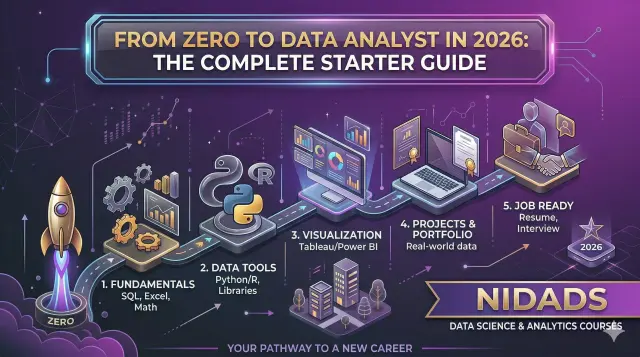
Table of contents
If you have come to this blog, that means you are interested in Data Analytics but unsure how to start your data analyst journey. You might be feeling a little bit of confusion that how to start, like should I watch YouTube tutorials, Go for online courses, or should I enroll in the reputed Institute for the proper offline classes. Also you also might be wondering what is the career scope of data analyst job role and what skills required to be one.
Firstly, don’t worry, you are at the right blog. Here we will equip you with the full step-by-step guide, along with the answers to the questions that is asked by people like you.
So, without any delay, let’s start!
Why Choose a Career in Data Analysis?
People are showing more interest in data analytics than ever. Understanding the reason behind this is not that hard. Among many, one reason is that the Data analyst roles are growing like crazy. And that is obvious, though, because we are living in an age where a huge amount of data is generated every day.
Also, companies are eagerly looking for individuals who can interpret data and drive meaningful results from that. So, yes, if you choose this, then you are securing your future in the most demanding field with lots of prospering opportunities.
Another reason why this career is gaining popularity is data analysts usually get good package and due to massive demand for them the opportunities are also high. So, all over entering this career is worth investing time and money.
Step 1: Understand What a Data Analyst Really Does
The role of data analyst is to solve business problems by turning raw data into useful information. They basically clean data, understand patterns, look at it closely, and communicate insights. Also, there is a misconception that a data analyst course with placement do coding all day but their much work is more about understanding business needs and solving them with their skills.
Here are a few things data analysts commonly work on:
- Tracking business performance
- Identifying customer behavior patterns
- Building dashboards for decision-making
- Cleaning messy datasets
- Creating reports for teams and stakeholders
This foundation helps you stay motivated throughout the journey because now you know what you’re working toward.
Step 2: Start With Basic Concepts (No Tools Yet)
Firstly you need to understand that you don’t need to go straight towards tools like Excel or Python. Before jumping on that ensure you have spend enough time on understand the basic building of data blocks. Same with the maths and coding, at the beginner level it is not necessary that you have to be great at this but surely will needed at the advance level.
So, how you are supposed to start this is like building a basic understanding, not worrying too much about the technical stuff if you are totally new to this field, and most important go for structured learning to avoid confusion. Start with learning simple statistics (averages, probability, and basic concepts). Do hands-on practice with spreadsheets and explore data. Remember a strong foundation is the base of your career.
Important concepts to learn at this stage include:
- Understanding data.
- Types of data (categorical, numeric)
- How to do data cleaning?
- What is data visualization?
- What is business intelligence?
Step 3: Learn Excel – Your First Real Skill
Many students overlook the excel but this is the biggest mistake you could do in your journey becoming a data analyst. Despite the Excel is the very starting point but puts a great impact on your whole career. This teaches you how to handle data, how data behaves, what formulas when to apply, and what is the process of exploring them to drive meaningful insights.
This is also the stage where the Duration of a Data Analyst course often begins — most short-term courses start with Excel because it’s simple yet powerful.
Excel skills to focus on:
- Basic formulas (SUM, AVERAGE, COUNT)
- Logical formulas (IF, AND, OR)
- Pivot tables and pivot charts
- Data cleaning techniques
- Sorting, filtering, and analyzing datasets
Excel alone can get you entry-level work, which is why so many professionals begin here.
Step 4: Learn SQL – The Language of Data
Once you get comfortable with Excel and have good command on it, then your second step is towards learning SQL. Most companies store their data in databases, and SQL is the language that you use while working on that data. So, yes if you want to be a successful data analyst or are wondering how to become a data analyst step by step, then learning SQL isn’t optional—it’s mandatory.
Here’s what you typically learn about SQL as a beginner in data analytics:
- Querying Data – Using SELECT statements to pull specific information from tables.
- Filtering and Sorting – Using WHERE, ORDER BY, and LIMIT to focus on relevant data.
- Aggregating Data – Using functions like SUM(), COUNT(), AVG() to summarize data.
- Joining Tables – Combining data from multiple tables using JOIN statements.
- Modifying Data – Adding, updating, or deleting records with INSERT, UPDATE, and DELETE.
- Creating and Managing Tables – Defining table structures with CREATE TABLE and changing them with ALTER TABLE.
SQL acts as a bridge between raw data available in databases and the result you want to deliver as a data analyst.
Step 5: Learn a Visualization Tool (Power BI or Tableau)
A data analyst doesn't only work on the data, but also in presenting the data in an easy to understand manner. Hence the reason for the visualization tools such as Power BI or Tableau. These tools let you take raw data and turn it into clear charts, graphs, and dashboards that tell a story.
The visualization tools help find patterns, trends, and insights that would otherwise remain hidden if presented in a spreadsheet. They help in communicating findings and ideas to non-data persons. Get hands-on with a visualization tool early in your data career.
This is the stage where you learn:
- How dashboards work
- How to build interactive reports
- How to use slicers and filters
- How to make charts understandable
- How to communicate insights clearly
Step 6: Learn Python
Well, for entry-level roles, it’s not mandatory to have Python skills, only SQL, Excel, and BI tools are enough. However, when you grow further, the Python skills become essential as at advanced roles you have to work with complex datasets.
Many companies expect intermediate-level analysts to know Python, so learning it early can give you a head start. Even mastering the basics can make your work more efficient and open doors to higher-level opportunities.
Features worth learning:
- Pandas (for data cleaning)
- NumPy (for numerical operations)
- Matplotlib & Seaborn (for visualization)
- Basic automation scripts
Python becomes especially useful when working with large datasets that Excel can’t handle.
Step 7: Start Doing Real Projects
Having practice on real projects is very important to get a high-paying job. By working on projects you get the real idea of how things work and the concepts become clearer that you have learned during the time of the course.
Use Free Datasets to Practice
Once you have a project idea, the next step is finding data. Fortunately, there are plenty of free datasets online. Some popular sources include:
- DataLab – An online IDE with pre-loaded datasets for coding and data practice.
- Kaggle – Thousands of real-world and synthetic datasets across countless topics.
- UCI Machine Learning Repository – Well-structured, clean, and documented datasets.
- FiveThirtyEight – Interactive articles with datasets used in mainstream analysis.
- Google Dataset Search – A search engine for more than 25 million public datasets.
With these resources, you can experiment, try out different projects, and sharpen your skill-set. And this will also help you out when you show up for an interview, there you can show the employer that you have handled real projects before this.
Final Tips to Stay Consistent
Learning data analysis can feel overwhelming at times, and not every day will be productive—but that’s perfectly normal. The key is to focus on steady progress, keep practicing, and stay patient with yourself. Small, consistent actions will add up over time and help you build real skills that last.
- Keep practicing even when you are confused.
- Learn in small steps. You can't absorb everything at once.
- Keep it short and consistent.
- Start projects early. You don’t need to feel “ready.”
- Be a part of the community. Explore and contribute to blogs, forums, and platforms like DizitalAdda.
If you strictly follow this roadmap, keep practicing, and be consistent, then trust me, you will learn data analytics faster. So, yes, having real skills is far better than merely holding a degree. On the path to becoming an expert Data Analyst, you only require structured learning, dedication, and lots of practice. Microsoft data analyst training
FAQs
1. What qualifications do you need to become a data analyst?
To become a data analyst, you don’t need to have a specific degree. A good skillset with the required knowledge can help you land a job faster, regardless of your background in tech. What matters most is having the right skills and knowledge, such as Excel, SQL, data visualization, and analytical thinking.
2. How do I start a career in data analytics?
Start your learning with building skills in Excel, SQL, and basic statistics, and if possible, then Python also. Practice with real projects and on real databases to get the better understanding of work. This will also help you build a strong portfolio to demonstrate it to the interviewer. Finally, apply for roles and show your expertise.
3. Can a data analyst earn 1 crore?
Indeed, but in a special case. Mostly this much salary is allotted only for those who are in senior-level roles such as AI specialists, business intelligence, or data science. But don’t worry, you can also reach that position, but initially you have to start with a standard salary package.
4. What are the 4 types of data analyst?
Data analysts often specialize in different areas. Common types include:
- Business Analyst
- Operations Analyst
- Marketing Analyst
- Financial Analyst
5. Is a data analyst an IT job?
Not strictly. While data analysts work closely with technology and databases, the role is more about analyzing information and solving business problems than traditional IT tasks like coding software or managing networks. It’s a hybrid role bridging business and technology.
6. Can I learn data analytics in 3 months?
Yes, you can, but it requires proper structured learning along with hands-on practice on live projects. Make your priorities clear, like do extra focus on building a strong foundation with Excel, SQL, Stats, and data visualization. Then don’t skip real practice, somehow get some projects to work on and make doubts clear. Apart from this, must keep in mind that gaining advance level of expertise that comes from years of experience is different.
Conclusion
Becoming a data analyst in 2026 is achievable when you follow a structured learning path and focus on practical skills. Start with data basics and Excel, then learn SQL, data visualization, and Python as you progress. Most importantly, data career outlook work on real-world projects to strengthen your portfolio and confidence. With consistent practice, patience, and the right guidance, you can develop job-ready skills and build a successful career in data analytics.
About the Author
Quick facts
Name: Deepanshu
From: Delhi
Education: MCA
Program: Data Science and Data Analytics
Placed in: NIDADS (National Institute of Data Analytics & Data Science)
Covers topics: Data Science, Data Analytics, Artificial Intelligence, Machine Learning, Data Engineering, Deep Learning
Currently working as: Senior Data Analyst
In his words: "Data doesn't just tell you what happened — it tells you what to build next. My job is to turn numbers into decisions that actually move the needle."