5/31/2026
Data AnalyticsData Analyst vs Business Analyst: What's the Difference in India 2026?
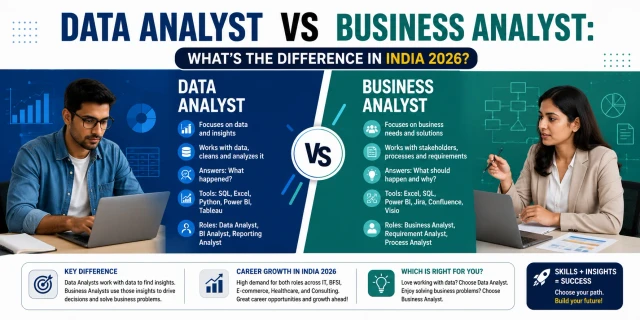
Table of contents
Picture two colleagues sitting in the same office meeting. One is staring at a SQL dashboard, trying to sort out why customer drop off went up last Tuesday for some reason. The other is on a call with the product team, mapping out a new user onboarding workflow, or at least trying to pin it down. Both are analysts — but honestly their day to day looks almost nothing alike.
If you have been trying to figure out the difference between data analyst and business analyst in India, you are not alone. It is one of the most common questions from students and career-switchers exploring analytics in 2026 — and it deserves a clearer answer than most guides give.
This article breaks down both roles honestly: what each one actually does day-to-day, which skills you need, what the salaries look like, and how to decide which path fits you.
What Does a Data Analyst Do in India?
A data analyst's core job is to work directly with data — extracting it, cleaning it, analysing patterns, and presenting findings that help teams make better decisions.
Think of the data analyst as the person who sorts out questions the business is already asking. Like, why did sales dip this quarter ? Which customer slice converts best , and where? What does the return rate look like by region, exactly.
Day-to-Day Responsibilities
- Writing SQL queries to pull data from databases
- Cleaning and organising raw datasets (which is messier than it sounds)
- Building dashboards and visual reports in Power BI or Tableau
- Identifying trends, patterns, and anomalies
- Presenting findings to managers and non-technical teams
- Supporting product, marketing, and operations teams with data-backed insights
Tools a Data Analyst Uses
Tool
Purpose
SQL
Querying databases
Excel / Google Sheets
Data organisation and quick analysis
Power BI / Tableau
Dashboard and report building
Python (basics)
Automating repetitive tasks, handling large datasets
Statistics
Interpreting patterns and trends accurately
What Does a Business Analyst Do in India?
A business analyst is less concerned with the data itself and more concerned with the problem behind it.
Where a data analyst lives inside databases and dashboards, a business analyst spends most of their time talking to people — understanding what different teams actually need, documenting how processes work, identifying where things break down, and figuring out how to fix them.
Day-to-Day Responsibilities
- Sitting with stakeholders to understand what's going wrong and why
- Gathering and documenting requirements for new processes or systems
- Mapping processes and spotting inefficiencies
- Writing business requirement documents (BRDs) and user stories
- Keeping the tech team and the business team on the same page
- Tracking whether proposed solutions actually worked
A Simple Example
Imagine a logistics company where the warehouse side keeps producing repeat delivery delays. A business analyst would, kinda quietly interview the warehouse manager, the dispatch team, and the customer service lead.
They then map out how things actually move, like from receiving to shipping, and where delays quietly sneak in. After that, they propose a revised workflow or maybe even a system solution that makes it more reliable. They might use data to back up the idea, but at the heart of it the real job is understanding the business, not just mining the numbers.
Did you know? Business analyst roles in India have grown significantly in BFSI (banking, financial services, and insurance), healthcare, and e-commerce — sectors undergoing rapid digital transformation. big data course
Difference Between Data Analyst and Business Analyst in India: Head-to-Head Comparison
Factor
Data Analyst
Business Analyst
Primary focus
Data, trends, and insights
Business processes and solutions
Core output
Reports, dashboards, visualisations
Process maps, BRDs, strategy recommendations
Technical depth
Higher — SQL, Python, statistics
Moderate — basic tools, BI reports
Communication
Important
Critical — most of the job is people-facing
Tools used
SQL, Python, Power BI, Tableau
Excel, Jira, Visio, Confluence, BI tools
Teams worked with
Data, product, and analytics teams
Business, management, and tech teams
Career growth paths
Data Scientist, BI Developer, ML Engineer
Product Manager, Strategy Analyst, Consultant
The clearest way to understand the difference between data analyst and business analyst in India: one role starts with a dataset, the other starts with a business conversation.
Skills Required: Data Analyst vs Business Analyst
Skills for Data Analysts in India
Technical skills are the foundation here.
- SQL — non-negotiable for almost every data analyst role
- Excel and Google Sheets — for quick analysis and everyday reporting
- Power BI or Tableau — building dashboards that tell a clear story
- Python basics — pandas, NumPy, data manipulation
- Statistics — enough to interpret what you're seeing correctly
- Analytical thinking — knowing what questions to ask, not just how to run queries
Skills for Business Analysts in India
Here, soft skills carry as much weight as technical ones.
- Communication — written, verbal, across seniority levels
- Requirement gathering — pulling out what stakeholders actually need, not just what they say they need
- Documentation — BRDs, process maps, user stories, meeting notes
- Domain knowledge — understanding the industry you're working in
- Stakeholder management — keeping everyone aligned even when priorities conflict
- Basic technical literacy — SQL and BI tools help, but they're a bonus, not a requirement
The skill difference is significant — which is why the two roles suit different personality types, not just different academic backgrounds.
Data Analyst vs Business Analyst Salary in India (2026)
Numbers vary by city, company size, and industry. Here is a realistic picture based on current market data from platforms like AmbitionBox and Glassdoor India.
Data Analyst Salary in India 2026
- Fresher (0–2 years): ₹3.5 – 6 LPA
- Mid-level (3–5 years): ₹7 – 14 LPA
- Senior Analyst (5+ years): ₹15 – 25+ LPA
Metro cities like Bengaluru, Hyderabad, and Mumbai offer higher bands. Companies in fintech, e-commerce, and SaaS tend to pay above the average.
Business Analyst Salary in India 2026
- Fresher (0–2 years): ₹4 – 7 LPA
- Mid-level (3–5 years): ₹8 – 16 LPA
- Senior BA (5+ years): ₹18 – 30+ LPA
Business analysts in consulting firms (Deloitte, Accenture, KPMG, TCS) and enterprise IT companies often reach higher salary bands earlier, especially with domain expertise in BFSI or healthcare.
Which Career Is Right for You in India?
Well, for this question there is no universal answer even it depends on one’s skills and interests.
Choose Data Analyst if you:
- Genuinely enjoy working with numbers and patterns
- Like building dashboards and visualisations
- Find satisfaction in solving puzzles with data
- Prefer structured, tool-driven work
- Want a clear, in-demand entry point into data careers
You're probably better suited to business analytics if:
- You'd rather understand a problem through conversation than a query
- You find org dynamics and cross-team collaboration interesting
- You like influencing decisions through strategy and communication
- You're drawn to project management and working across functions
- You want to sit at the intersection of business thinking and technology
Can You Switch Between the Two Roles?
Yes — and it happens often in India's analytics job market.
Data analysts, with solid communication skills and real domain know how often kind of drift into business analyst roles. And business analysts who also upskill via SQL, Python, and dashboards can later move into data positions. Honestly both lanes are fine , and a lot of senior professionals, they already carry capabilities from both angles so it works out. business analysis and business data analytics
The key is knowing which side to start from based on your current strengths, so you can gain traction quickly and build from there.
How to Start Your Analytics Career in India
There are two option, one is you can learn from the free available sources like videos that are on YouTube. However the free ones also comes up with the confusing set up like there is no structured format and this leads students to drop this course.
Whereas a structured learning with live mentorship, hands-on projects, and career guidance makes a measurable difference in how quickly you progress from learning to employment.
NIDADS offers programmes designed for students, graduates, and working professionals entering the analytics field:
- Diploma in Data Analytics & AI
- Diploma in Data Science & AI
- Advanced Certification Programmes
- Short-term certification tracks
Here, courses include live training, module wise projects, industry tools, placement support, and career guidance — giving you a structured path and motivation for going ahead.
Conclusion
Data Analysts and Business Analysts both help organizations make better decisions, but their responsibilities and focus are different. Data Analysts work more with data, tools, and insights, while Business Analysts focus on business needs, processes, and solutions. The right career depends on your interests, strengths, and goals. Build relevant technical and communication skills, gain practical experience, and choose the role that best matches your career path for long-term growth. what is business analysis
About the Author
Quick facts
Name: Deepanshu
From: Delhi
Education: MCA
Program: Data Science and Data Analytics
Placed in: NIDADS (National Institute of Data Analytics & Data Science)
Covers topics: Data Science, Data Analytics, Artificial Intelligence, Machine Learning, Data Engineering, Deep Learning
Currently working as: Senior Data Analyst
In his words: "Data doesn't just tell you what happened — it tells you what to build next. My job is to turn numbers into decisions that actually move the needle."