5/16/2026
Data ScienceCareer Change to Data Science in 2026: What to Expect Before You Switch
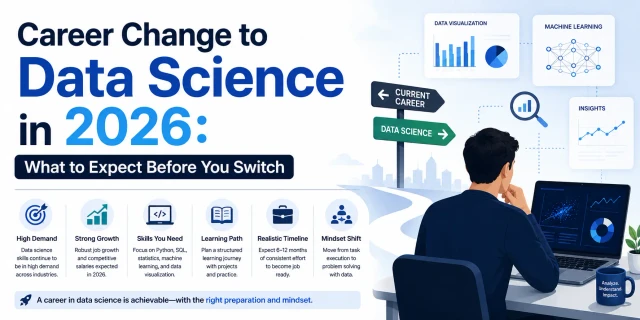
Table of contents
Table of Contents
- Why So Many Indians Are Choosing Data Science in 2026
- Quick Answer: Is a Career Change to Data Science Worth It?
- What Has Changed in Data Science After the AI Boom
- Who Should Switch to Data Science in 2026
- Skills You Actually Need Before Switching
- Best AI Tools Data Professionals Are Using in 2026
- Data Science Salary Expectations in India
- Best Learning Path for Beginners and Working Professionals
- Step-by-Step Plan to Switch Into Data Science
- Common Mistakes People Make During a Career Change to Data Science
- FAQ
Why So Many Indians Are Choosing Data Science in 2026
A career change to data science in 2026 is opening new opportunities for Indian businesses. As companies are growing and demanding professionals who can use AI tools, automate tasks, analyse business data, and build dashboards.
The market has changed really fast, like almost too fast. Companies in finance, e-commerce, healthcare, logistics, and marketing are now hiring data professionals who can interpret data and put AI into action to help decisions happen faster. You do not strictly need a computer science degree from IIT to get in.
We've seen working professionals from sales, BPO, accounting, operations, and even teaching successfully move into data roles after learning practical tools like SQL, Power BI, Python, and ChatGPT-based analytics workflows.
According to the World Economic Forum, data roles will remain among the fastest-growing jobs through 2030, while India’s analytics market continues to see massive growth.
Quick Answer: Is a Career Change to Data Science Worth It?
Quick Answer:
Yeah, if you’re thinking about a career change into data science course during 2026, it could be worth it, as long as you’re willing to pick up practical business analytics, use AI tools and keep sharpening real problem-solving instincts. In many cases, the area is started rewarding adaptability more than just having a high-end degree , especially in India where firms often want folks who can automate reporting, measure shifts in trends , and collaborate alongside AI systems.
What Has Changed in Data Science After the AI Boom
AI Has Reduced Manual Work
In 2020, analysts used to spent infinite hours in managing spreadsheets and excel sheet and handling repetitive SQL tasks. But by 2026, the huge part of repetitive tasks is now handled by AI tools.
Some famous tools such as ChatGPT, Gemini, Claude and Microsoft Copilot now helping analyst to generate formulas, write SQL queries and explain what are trending and even create dashboards.
This scares some professionals. But honestly, we've noticed something interesting in the industry. The people losing jobs aren't data professionals. They're professionals who refused to adapt to AI-assisted workflows.
Companies Want Hybrid Skills
Pure coding alone isn't enough anymore.
A modern data professional needs:
- Business understanding
- Communication skills
- AI tool familiarity
- Dashboard storytelling
- Basic automation knowledge
According to LinkedIn's Jobs on the Rise report, AI and data analytics roles continue to dominate hiring trends across Asia.
Degrees Matter Less Than Proof of Work
The hiring decisions have changed now. What really matters today is the proof of your work, which means real work experience. So, yes, you can say that degrees matter less than your proof of work.
This shift has made the field more accessible. You don’t necessarily need a top-tier degree anymore; you need a strong portfolio that shows your ability to solve real business problems using data.
Recruiters now care more about:
- Portfolio projects
- GitHub work
- Dashboard samples
- Real business problem-solving
A candidate with practical Power BI dashboards often beats someone with only certificates.
That's especially true for data science for working professionals India because employers know experienced professionals already understand business operations.
Who Should Switch to Data Science in 2026
Working Professionals Feeling Stuck
Many professionals notice their growth kind of slowing after 4–6 years in support, operations, or reporting work, especially once the salary and promotion lanes start to plateau, you know.
Data science can act like a strong lever to push past that ceiling by upgrading your skills toward a high-demand, future-focused discipline, and you usually do it without having to restart your full career, from zero, again.
We've seen:
- MIS executives become Power BI analysts
- Accountants move into financial analytics
- Digital marketers shift into marketing analytics
- Customer support managers transition into business intelligence roles
12th Pass Students Looking for Skill-Based Careers
Well, college degrees still matter in India. But having skills can set you apart, as skill-first hiring is growing fast. And the time after completing 12th is considered best to learn and master skills.
Many startups now care more about:
- Portfolio projects
- Internships
- Tool knowledge
- Problem-solving ability
If a student learns SQL, Excel, Power BI, and basic Python by age 19 or 20, they can already compete for internships and entry-level analytics roles.
People Looking to Switch to Data Science After 30
Yes, it's absolutely possible to switch to data science after 30. As there is no specific age defined for learning skills, you can learn whenever you want to upgrade yourself.
In fact, experienced professionals often perform better because they already understand:
- Client communication
- Business KPIs
- Team collaboration
- Industry workflows
Skills You Actually Need Before Switching
Excel Still Matters More Than People Admit
A surprising number of beginners ignore Excel because they think AI has replaced it.
This is a very Big mistake. According to Microsoft workplace reports, Excel remains one of the most-used business tools globally. Most Indian companies still depend heavily on spreadsheets.
Learn:
- Pivot tables
- XLOOKUP
- Power Query
- Basic automation
- Dashboard creation
SQL Is Non-Negotiable
SQL is something that is non-negotiable and if you are really serious about your career in data analytics then you can’t ignore it or take is lightly. Even AI-generated SQL needs human checking.
SQL (Structured Query Language) is used to manage and work with data stored in databases. Its main tasks include:
- Extracting data (reading information from tables)
- Filtering and sorting data
- Combining data from multiple tables
- Updating or deleting records
- Creating reports for analysis
In simple terms, SQL helps you get and organize data so analysts can turn it into insights for business decisions.
Focus on:
- Joins
- Group By
- Window functions
- Data cleaning
- Query optimization
Power BI Is Exploding in India
Power BI adoption has grown massively because Indian companies want affordable analytics solutions. A strong Power BI portfolio can get interviews faster than theoretical machine learning knowledge.
What Power BI does:
- Connects to multiple data sources (Excel, SQL, cloud, etc.)
- Cleans and transforms data
- Creates interactive visual reports
- Helps track business performance in real time
- Enables data-driven decision-making
Python Helps — But Don't Overcomplicate It
You don't need advanced algorithms on Day 1. Most entry-level analytics jobs don't require deep AI model building.
Learn:
- Pandas
- NumPy
- Data cleaning
- Visualization basics
- API handling
Best AI Tools Data Professionals Are Using in 2026
The smartest professionals in 2026 aren't working harder. They're automating repetitive tasks.
Here's a realistic comparison of tools actually helping analysts and data professionals today.
Tool
Main Use
Best For
Approx Pricing
ChatGPT
SQL, automation, analysis help
Beginners & professionals
₹1,700–₹2,000/month
Microsoft Copilot
Excel + Office AI workflows
Corporate users
Included in some MS plans
Claude
Long document analysis
Reporting & research
Freemium
Power BI AI Features
Dashboard insights
Business analytics
Free + Pro plans
Google Gemini
Data summaries & Sheets AI
Google Workspace users
Freemium
Tableau Pulse
AI-driven dashboards
Enterprise teams
Enterprise pricing
Data Science Salary Expectations in India
Salary depends heavily on practical skills and industry domain.
Here's a realistic range for 2026:
Role
Experience
Average Salary in India
Junior Data Analyst
Fresher
₹4–6 LPA
Power BI Developer
1–3 Years
₹6–10 LPA
Business Analyst
2–5 Years
₹8–14 LPA
Data Scientist
3–6 Years
₹12–22 LPA
Analytics Manager
6+ Years
₹20 LPA+
According to Glassdoor and AmbitionBox trends, professionals with cloud analytics and AI-assisted reporting experience are seeing higher salary growth compared to traditional reporting roles.
Best Learning Path for Beginners and Working Professionals
The best learning path for beginners and working professionals is one that follows a structured learning path. The biggest advantage of gaining skills through a structured and comprehensive curriculum is that you can easily sideline the unwanted topics and distraction.
That’s where NIDADS kinda stands out, honestly. Whether you’re a 12th pass student, a beginner, or a working professional, NIDADS keeps the focus on practical, real-world industry skills that companies actually expect in 2026. Rather than burying learners under unnecessary theory, the platform teaches instead, like: machine learning course
- Excel
- SQL
- Power BI
- Python basics
- AI-assisted analytics
- Real business projects
A good data science online course for professionals should provide structure, accountability, and practical exposure. That’s exactly why many learners today prefer guided platforms like NIDADS over scattered free tutorials.
Read more: Data Science Courses After 12th Science
Step-by-Step Plan to Switch Into Data Science
Step 1: Learn Excel and SQL Together
Spend 30–45 days building reporting skills.
This helps you understand how businesses organize and analyze data before jumping into advanced tools.
Expected Outcome:
You'll become comfortable handling datasets and answering business questions.
Step 2: Build Two Dashboard Projects
Create projects using:
- Sales data
- Marketing campaigns
- Customer behavior analysis
Recruiters love visual proof of skills.
Expected Outcome:
You'll have portfolio samples for interviews and LinkedIn.
Step 3: Learn AI-Assisted Analytics
Start using:
- ChatGPT for SQL
- Copilot for Excel
- AI chart summaries
- Dashboard automation
This is becoming a core workplace expectation.
Expected Outcome:
You work faster and stand out in interviews.
Step 4: Learn Basic Python
Focus only on practical use cases first.
Avoid spending months memorizing theory.
Expected Outcome:
You'll automate repetitive tasks and handle larger datasets.
Step 5: Apply Before You Feel Fully Ready
Many learners delay applications unnecessarily.
The industry rewards practical experience more than perfect preparation.
Expected Outcome:
You'll gain interview confidence and understand real hiring expectations.
Common Mistakes People Make During a Career Change to Data Science
Learning Too Many Things at Once
Beginners often try:
- Python
- Machine learning
- Deep learning
- Cloud computing
- Tableau
- NLP
...all at the same time.
So, avoid bulk learning cause that may end with nothing.
Ignoring Communication Skills
Those data professionals who can communicate efficiently about insights are more likely to grow faster in their field. And that’s the reason that many with extremely great technical skills failed to crack the interview, just because of their low communication skills.
Copy-Pasting AI Output Blindly
This is becoming a major issue. Companies can quickly identify candidates who rely completely on AI-generated answers without understanding concepts.
AI should assist your thinking — not replace it.
FAQ
1. Is a career change to data science still worth it in 2026?
Yes, it does. The field of data science is growing unexpectedly and is also opening doors to many global opportunities. But there is a twist that you must be aware of, trendy AI tools cause companies to look for only those who can help them to automate their tasks and analyze customers behaviour patterns.
2. Can I switch to data science after 30 in India?
Yes, you can; there are no boundaries on age for upskilling yourself. Even this is a plus point for you cause you might already have industry experience and better communication skills.
3. Do I need coding experience before learning data science?
No. Beginners can start with Excel, SQL, and Power BI before moving into Python. Many entry-level analytics jobs focus more on data interpretation and reporting than advanced programming.
4. Which AI tools should data analysts learn in 2026?
Well, many AI tools are emerging, but some famous ones are ChatGPT, Microsoft Copilot, Power BI AI features and Claude. They help automate SQL writing, reporting, dashboard summaries, and documentation tasks.
5. What is the best data science online course for professionals?
The best path is one that’s sort of focused on real practical projects, building a portfolio, interview readiness, and AI assisted workflows. Try finding a program that has live mentorship and business case studies, not just recorded theory sessions that are kinda passive, you know.
6. How long does it take to become job-ready in data science?
Most people end up interview ready within about 6–9 months if they practice every day consistently. Working professionals who study part time might need something like 9–12 months, depending on their learning pace, and also how strong the projects are.
Conclusion
A career change to data science can be a rewarding opportunity for professionals ready to learn and adapt. You do not need to start from zero; your existing industry knowledge can become a valuable advantage when combined with skills like Python, SQL, statistics, machine learning, and data visualization. Build practical projects, strengthen your portfolio, and learn consistently. With the right roadmap, hands-on practice, and patience, you can confidently transition into a successful data science career. Future of Jobs Report 2025
About the Author
Quick facts
Name: Shagun
From: Delhi
Education: B.Tech
Program: Data Science and Data Analytics
Placed in: NIDADS (National Institute of Data Analytics & Data Science)
Covers topics: Data Science, Data Analytics, Artificial Intelligence, Machine Learning, Data Engineering, Deep Learning
Currently working as: Senior Data Science Trainer
In her words: "The best way to learn data science isn't just solving problems — it's understanding why the solution works. That's what I try to teach every single day."